Skip to main content
Genetics
My Course
Learn
Exam Prep
AI Tutor
Study Guides
Textbook Solutions
Flashcards
Explore
Try the app
My Course
Learn
Exam Prep
AI Tutor
Study Guides
Textbook Solutions
Flashcards
Explore
Try the app
Back
Sequencing the Genome definitions
You can tap to flip the card.
Genomic DNA
You can tap to flip the card.
👆
Genomic DNA
Entire genetic material of an organism, fragmented for sequencing to reveal the order of nucleotides across all chromosomes.
Track progress
Control buttons has been changed to "navigation" mode.
1/15
Related flashcards
Related practice
Recommended videos
Sequencing the Genome quiz
Sequencing the Genome
15 Terms
Sequencing the Genome
15. Genomes and Genomics
7 problems
Topic
Kylia
Genomic Variation
15. Genomes and Genomics
2 problems
Topic
Nicole
15. Genomes and Genomics - Part 1 of 2
5 topics
10 problems
Chapter
Kylia
15. Genomes and Genomics - Part 2 of 2
4 topics
10 problems
Chapter
Kylia
Guided course
04:17
Traditional vs. Next-Gen
1012
views
7
rank
Guided course
08:41
Sequencing Difficulties
922
views
4
rank
Guided course
08:55
Sequencing Overview
1390
views
7
rank
1
comments
Terms in this set (15)
Hide definitions
Genomic DNA
Entire genetic material of an organism, fragmented for sequencing to reveal the order of nucleotides across all chromosomes.
Restriction Enzyme
Protein that recognizes specific DNA sequences and cuts DNA, generating fragments for sequencing.
Read
Short, overlapping DNA fragment produced during sequencing, essential for reconstructing the original sequence.
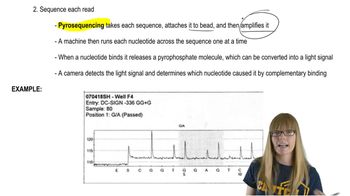
Pyrosequencing
Technique detecting DNA sequence by measuring light signals released during nucleotide incorporation.
Consensus Sequence
Composite DNA sequence assembled from overlapping reads, representing the most common base at each position.
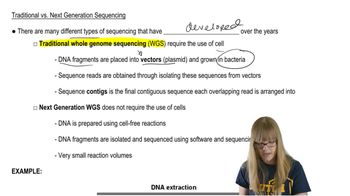
Traditional Whole Genome Sequencing
Method using bacterial cells to amplify DNA fragments inserted into plasmids before sequencing.
Next Generation Sequencing
Automated, high-throughput approach using small reaction volumes and cell-free amplification for rapid DNA sequencing.
Repetitive DNA Sequence
Long stretches of repeated nucleotide patterns in the genome, complicating sequence assembly and alignment.
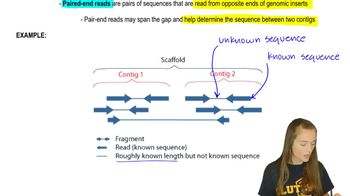
Paired End Read
Sequencing strategy reading both ends of a DNA fragment, aiding alignment across repetitive or unknown regions.
Sequence Assembly
Computational process of aligning and merging overlapping reads to reconstruct the original DNA sequence.
Contig
Continuous DNA sequence built from overlapping reads, representing a segment of the genome.
Vector
Circular DNA molecule, often a plasmid, used to carry and replicate DNA fragments in bacteria during sequencing.
Dideoxynucleotide
Modified nucleotide lacking a 3' hydroxyl group, causing chain termination during DNA synthesis in Sanger sequencing.
Sanger Sequencing
Classic sequencing method using dideoxynucleotides to terminate DNA synthesis, generating fragments for sequence determination.
Alignment
Arrangement of DNA sequences to identify regions of similarity, essential for detecting insertions, deletions, or rearrangements.
 BackBack

 04:17
04:17