The first step is to chop the genomic DNA into random, overlapping fragments using restriction enzymes.
What are the overlapping DNA fragments generated during sequencing called?
These overlapping fragments are called reads.
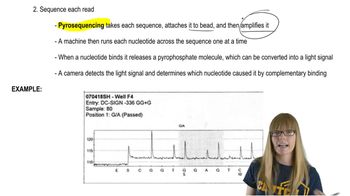
How does pyrosequencing detect the sequence of DNA?
Pyrosequencing detects the sequence by measuring light signals released when nucleotides are incorporated into the DNA strand.
Why are overlapping reads important in genome sequencing?
Overlapping reads are important because they allow sequencing software to assemble the full genome by matching overlapping regions.
What is a consensus sequence in genome assembly?
A consensus sequence is the assembled sequence that represents the most common nucleotide at each position, accounting for individual differences.
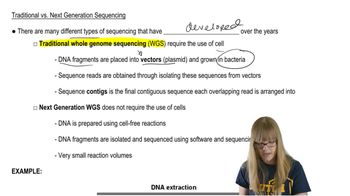
How does traditional whole genome sequencing amplify DNA fragments?
Traditional sequencing amplifies DNA fragments by inserting them into bacterial plasmids (vectors) and growing the bacteria.
What is a key difference between traditional and next generation whole genome sequencing?
Traditional sequencing uses cells and bacteria for amplification, while next generation sequencing uses automated, cell-free reactions in small volumes.
Why do repetitive DNA sequences make genome assembly difficult?
Repetitive sequences are hard to align and assemble because it's difficult to determine where they begin and end in the genome.
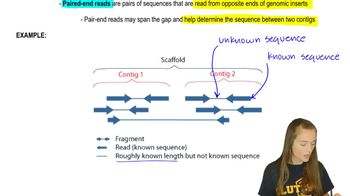
What are paired end reads and why are they useful?
Paired end reads are sequences from both ends of a DNA fragment, useful for aligning repetitive regions and detecting genome changes.
How can paired end reads help identify genome rearrangements?
Paired end reads can reveal insertions, deletions, inversions, and duplications by comparing the distance and orientation of known sequences.
What special nucleotides are used in Sanger sequencing to stop DNA replication?
Sanger sequencing uses dideoxynucleotides (ddNTPs), which terminate DNA strand elongation when incorporated.
How does Sanger sequencing determine the DNA sequence?
It generates DNA fragments of varying lengths that end at each nucleotide, then separates them by size to deduce the sequence.
What is the purpose of using a small amount of ddNTPs in Sanger sequencing?
A small amount ensures that most replication proceeds normally, but occasional incorporation creates fragments ending at each nucleotide.
What is sequence assembly in genome sequencing?
Sequence assembly is the process of using software to overlap and connect reads to reconstruct the full genome sequence.
Why is it necessary to have multiple reads covering each base pair in genome sequencing?
Multiple reads ensure accuracy and help create a reliable consensus sequence by covering each base pair several times.
 Back
Back

 04:17
04:17