Back

Variations of Dominance definitions

Control buttons has been changed to "navigation" mode.
1/15
  • Complete Dominance

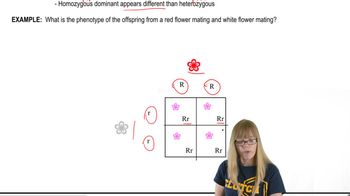
    A genetic scenario where the presence of a dominant allele masks the effect of a recessive allele, resulting in identical phenotypes for homozygous and heterozygous genotypes.
  • Incomplete Dominance

    A genetic condition where heterozygotes display a phenotype intermediate between those of the two homozygotes, reflecting the dosage of dominant alleles.
  • Codominance

    A genetic pattern where two different dominant alleles are both fully and equally expressed in the phenotype, as seen in certain blood types.
  • Phenotype

    The observable traits or characteristics of an organism, determined by its genotype and the interaction of alleles.
  • Genotype

    The genetic makeup of an organism, specifically the combination of alleles present at a given locus.
  • Homozygous

    A genetic state where both alleles at a locus are identical, either both dominant or both recessive.
  • Heterozygous

    A genetic state where two different alleles are present at a locus, one dominant and one recessive.
  • Dominant Allele

    A variant of a gene that expresses its trait in the presence of another allele, masking the effect of a recessive allele.
  • Recessive Allele

    A gene variant whose trait is masked in the presence of a dominant allele and only expressed when homozygous.
  • Punnett Square

    A diagrammatic tool used to predict the possible genetic outcomes and ratios of offspring from a particular cross.
  • ABO Blood Type System

    A classification based on the presence or absence of A and B antigens, determined by codominant alleles IA and IB.
  • IA Allele

    A gene variant responsible for the A antigen in the ABO blood group, showing dominance and codominance with IB.
  • IB Allele

    A gene variant responsible for the B antigen in the ABO blood group, showing dominance and codominance with IA.
  • Blood Type AB

    A phenotype resulting from the presence of both IA and IB alleles, where both A and B antigens are equally expressed.
  • Blood Type O

    A phenotype resulting from the absence of both IA and IB alleles, characterized by the lack of A and B antigens.