 Back
Week 5
Study Guide - Smart Notes
 Tailored notes based on your materials, expanded with key definitions, examples, and context.
Chromosome Changes, Organelle Inheritance & DNA Structure
Overview
This study guide covers chromosome mutations, organelle inheritance, and DNA structure and analysis, focusing on key concepts from Genetics Chapters 8, 9, and 10. Topics include chromosome number and structural changes, mitochondrial and chloroplast inheritance, and the molecular basis of genetic material.
Learning Goals
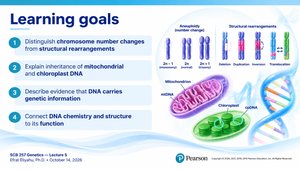
Distinguish chromosome number changes from structural rearrangements.
Explain inheritance of mitochondrial and chloroplast DNA.
Describe evidence that DNA carries genetic information.
Connect DNA chemistry and structure to its function.
Chromosome Mutations
Major Categories
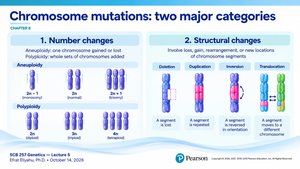
Chromosome mutations are classified into two main types: changes in chromosome number and structural changes.
Number changes: Aneuploidy (gain/loss of one chromosome) and polyploidy (gain of entire sets).
Structural changes: Include deletion, duplication, inversion, and translocation of chromosome segments.
Aneuploidy vs. Polyploidy
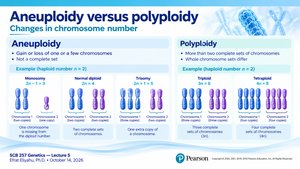
Aneuploidy and polyploidy are two distinct types of chromosome number changes.
Aneuploidy: Gain or loss of one or a few chromosomes (e.g., monosomy, trisomy).
Polyploidy: More than two complete sets of chromosomes (e.g., triploid, tetraploid).
Example: Trisomy 21 (Down syndrome) is a form of aneuploidy; triploid plants are examples of polyploidy.
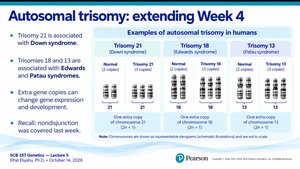
Autosomal Trisomy in Humans
Autosomal trisomy involves the presence of an extra chromosome and is associated with specific syndromes.
Trisomy 21: Down syndrome
Trisomy 18: Edwards syndrome
Trisomy 13: Patau syndrome
Extra gene copies can change gene expression and development.
Polyploidy in Plants
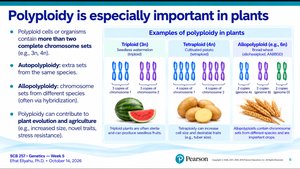
Polyploidy is especially important in plants, contributing to evolution and agriculture.
Autopolyploidy: Extra sets from the same species.
Allopolyploidy: Chromosome sets from different species (via hybridization).
Polyploidy can increase size, yield, and stress resistance.
Examples: Triploid watermelon, tetraploid potato, allopolyploid wheat.
Structural Chromosome Changes
Types of Structural Changes
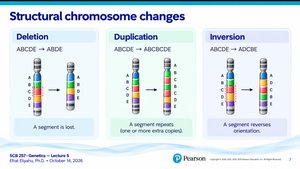
Structural changes alter the arrangement of chromosome segments.
Deletion: Loss of a segment (e.g., ABCDE → ABDE).
Duplication: Repetition of a segment (e.g., ABCDE → ABCBCDE).
Inversion: Reversal of a segment's orientation (e.g., ABCDE → ADCBE).
Translocation
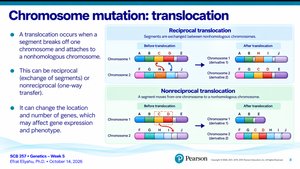
Translocation occurs when a segment breaks off and attaches to a nonhomologous chromosome.
Reciprocal translocation: Exchange of segments between two chromosomes.
Nonreciprocal translocation: Segment moves to another chromosome without exchange.
Translocation can change gene location and number, affecting gene expression and phenotype.
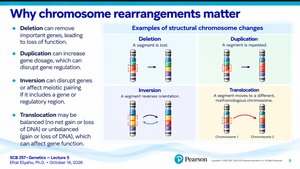
Why Chromosome Rearrangements Matter
Chromosome rearrangements can have significant effects on gene function and regulation.
Deletion: Loss of function due to missing genes.
Duplication: Increased gene dosage, affecting regulation.
Inversion: Disrupted gene function or pairing.
Translocation: Altered gene function due to changed location or dosage.
Applying Chromosome Mutation Concepts
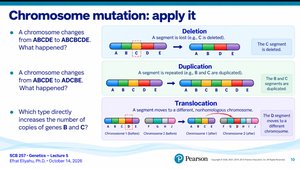
Understanding how chromosome changes affect gene arrangement is crucial for genetic analysis.
Deletion: Segment is lost (e.g., C segment).
Duplication: Segment is repeated (e.g., B and C segments).
Translocation: Segment moves to a different chromosome.
Extranuclear Inheritance
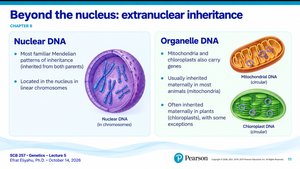
Nuclear vs. Organelle DNA
Genetic information can be inherited from both nuclear and organelle DNA.
Nuclear DNA: Linear chromosomes, Mendelian inheritance.
Organelle DNA: Mitochondria and chloroplasts, often inherited maternally.
Organelle Heredity
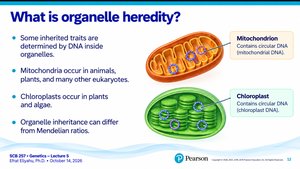
Some traits are determined by DNA inside organelles, with inheritance patterns differing from Mendelian ratios.
Mitochondria: Circular DNA, found in animals, plants, and eukaryotes.
Chloroplasts: Circular DNA, found in plants and algae.
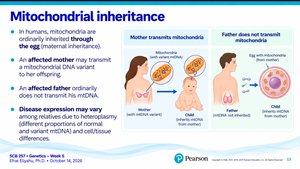
Mitochondrial Inheritance
Mitochondria are usually inherited maternally in humans, with affected mothers transmitting mtDNA variants to offspring.
Affected mother: May transmit variant mtDNA.
Affected father: Ordinarily does not transmit mtDNA.
Disease expression may vary due to proportions of normal and variant mtDNA.
Heteroplasmy: Mixed Mitochondrial Genomes
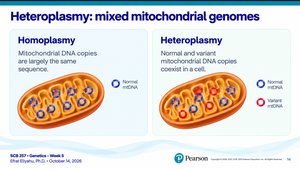
Cells can contain both normal and variant mitochondrial DNA, affecting disease expression.
Homoplasmy: All mtDNA copies are the same.
Heteroplasmy: Normal and variant mtDNA coexist in a cell.
Why Mitochondrial Disorders Can Vary
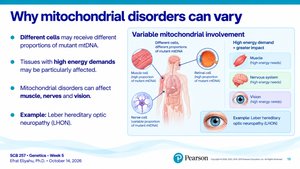
Mitochondrial disorders can affect different tissues and organs, especially those with high energy demands.
Different cells may receive different proportions of mutant mtDNA.
High energy demand tissues (muscle, nerves, vision) are often affected.
Example: Leber hereditary optic neuropathy (LHON).
Chloroplast Inheritance Example: Mirabilis jalapa
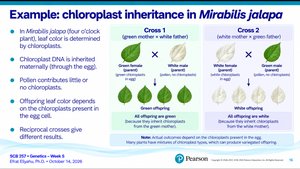
Chloroplast DNA is inherited maternally in Mirabilis jalapa, with leaf color determined by chloroplasts present in the egg cell.
Pollen does not contribute chloroplasts.
Reciprocal crosses give different results.
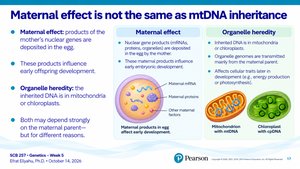
Maternal Effect vs. Organelle Heredity
Maternal effect involves products of the mother's nuclear genes deposited in the egg, influencing early development. Organelle heredity involves DNA in mitochondria or chloroplasts.
Both may depend on the maternal parent, but for different reasons.
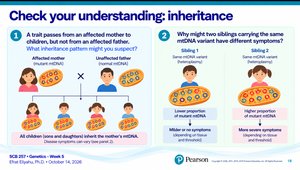
Check Your Understanding: Inheritance
Maternal inheritance: Traits pass from affected mother to children, not from affected father.
Variable symptoms: Siblings carrying the same mtDNA variant may have different symptoms due to different proportions of mutant mtDNA.
DNA Structure and Genetic Material
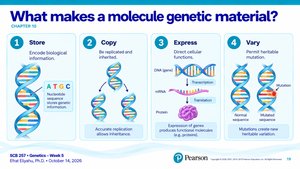
What Makes a Molecule Genetic Material?
Genetic material must be able to store, copy, express, and vary biological information.
Store: Encode information (e.g., DNA sequence).
Copy: Be replicated and inherited.
Express: Direct cellular functions (transcription, translation).
Vary: Permit heritable mutation.
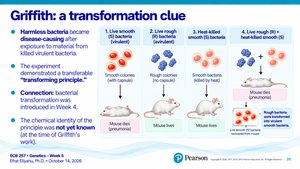
Griffith's Transformation Experiment
Griffith demonstrated that harmless bacteria could become disease-causing after exposure to material from killed virulent bacteria, indicating a "transforming principle."
Transformation clue for genetic material.
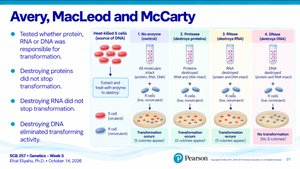
Avery, MacLeod, and McCarty Experiment
These scientists tested whether protein, RNA, or DNA was responsible for transformation. Destroying DNA eliminated transforming activity, supporting DNA as genetic material.
Destroying proteins or RNA did not stop transformation.
Destroying DNA stopped transformation.
Hershey–Chase Experiment
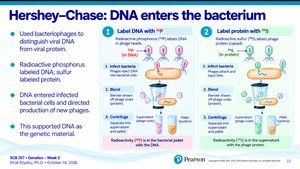
Used bacteriophages to show that DNA, not protein, enters bacteria and directs production of new phages, supporting DNA as genetic material.
Radioactive phosphorus labeled DNA; radioactive sulfur labeled protein.
DNA entered cells, not protein.
Nucleotides: Building Blocks of DNA
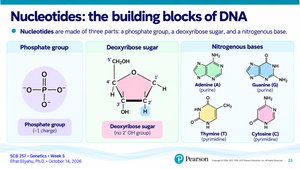
Nucleotides are composed of a phosphate group, deoxyribose sugar, and a nitrogenous base.
Phosphate group: Provides negative charge.
Deoxyribose sugar: Five-carbon sugar.
Nitrogenous base: Adenine, guanine, cytosine, thymine.
DNA Bases: Two Chemical Families
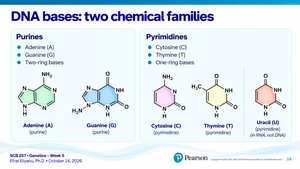
DNA bases are classified as purines (two-ring) and pyrimidines (one-ring).
Purines: Adenine (A), Guanine (G).
Pyrimidines: Cytosine (C), Thymine (T), Uracil (U in RNA).
Key Equations and Concepts
Chromosome number: (diploid), (triploid), (tetraploid)
DNA nucleotide:
