 Back
BackDiscovery of DNA and the Central Dogma of Molecular Genetics
Study Guide - Smart Notes
 Tailored notes based on your materials, expanded with key definitions, examples, and context.
Discovery of DNA as the Hereditary Molecule
Introduction to Molecular Genetics
Molecular genetics investigates how genes are structured, expressed, and inherited at the molecular level. It connects the DNA sequence to observable traits through the processes of transcription and translation, linking genetic information to the functions that sustain life.
Key Questions: How is genetic information stored, copied, and expressed? How do changes in DNA lead to variation or disease?
Core Processes: DNA replication, transcription, and translation (the Central Dogma).
Criteria for Genetic Material
For a molecule to serve as genetic material, it must fulfill several essential criteria:
Replication: Ability to make accurate copies of itself.
Information Storage: Capacity to store vast amounts of genetic information.
Expression: Ability to direct the synthesis of proteins and cellular functions.
Variation by Mutation: Capacity to change, allowing for genetic diversity.
Major Biological Macromolecules
Deoxyribonucleic Acid (DNA): The primary storage molecule for genetic instructions. Monomer: deoxyribonucleotide.
Ribonucleic Acid (RNA): Expresses the information in DNA, acting as messenger, catalyst, and regulator. Monomer: ribonucleotide.
Proteins and Enzymes: Build cellular structures and perform cellular work. Monomer: amino acid.
Key Experiments in the Discovery of DNA
Griffith’s Transformation Experiment (1928)
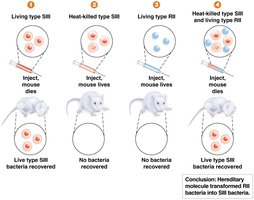
Frederick Griffith studied two strains of Pneumococcus bacteria to determine if a molecule from dead cells could cause heritable changes in living cells.
S strain (smooth): Has a capsule, pathogenic, causes pneumonia in mice.
R strain (rough): Lacks capsule, nonpathogenic, harmless.
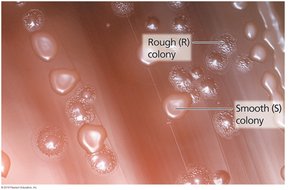
Griffith’s key discovery was the "transforming principle": a substance from dead S cells that permanently changed live R cells into the virulent S type, demonstrating that hereditary information can be transferred chemically.
Avery, MacLeod & McCarty (1944): Identifying the Transforming Molecule
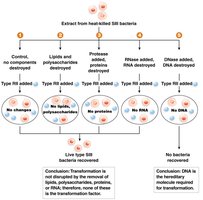
Oswald Avery, Colin MacLeod, and Maclyn McCarty built on Griffith’s work to identify the transforming principle. They selectively destroyed proteins, RNA, or DNA in heat-killed S cells and tested for transformation.
Result: Transformation still occurred when proteins or RNA were destroyed, but stopped when DNA was destroyed with DNase.
Conclusion: DNA is the hereditary molecule responsible for transformation.
Hershey & Chase (1952): DNA as the Genetic Material
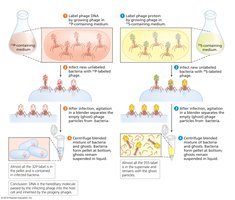
Alfred Hershey and Martha Chase used bacteriophage T2 (a virus composed of DNA and protein) to determine which molecule carries hereditary information in viruses. They labeled DNA with 32P and protein with 35S to track which component entered E. coli cells during infection.
Result: 32P (DNA) was found inside the bacteria, while 35S (protein) remained outside.
Conclusion: DNA, not protein, carries genetic information and directs viral reproduction.
Evidence for DNA Structure and the Central Dogma
Discovery of DNA Structure
Key evidence for the double-helix structure of DNA came from:
Rosalind Franklin’s X-ray diffraction studies (revealed helical structure).
Chargaff’s base ratios: Amounts of adenine equal thymine, and guanine equals cytosine.
The Central Dogma of Molecular Biology
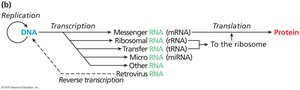
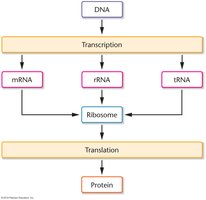
The Central Dogma describes the flow of genetic information in cells: DNA is transcribed into RNA, which is then translated into protein. This process is fundamental to all cellular life.
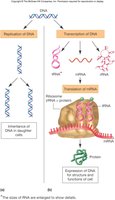
Replication: DNA is copied before cell division, ensuring genetic continuity.
Transcription: DNA serves as a template for RNA synthesis.
Translation: RNA is used as a template to synthesize proteins.

Gene Expression: Transcription and Translation
Gene expression involves two main steps:
Transcription: DNA is used as a template to make RNA (mRNA, tRNA, rRNA).
Translation: The ribosome reads mRNA to synthesize a polypeptide chain (protein). tRNA delivers amino acids, and rRNA forms part of the ribosome.
DNA Replication
Replication is the process of copying the genetic blueprint. Each new DNA molecule contains one old and one new strand (semiconservative replication), ensuring accurate transmission of genetic information.
Occurs before cell division to preserve genetic information.
Semiconservative mechanism: Each daughter DNA molecule consists of one parental and one newly synthesized strand.
Summary Table: Key Experiments in the Discovery of DNA
Experiment | Key Question | Method | Conclusion |
|---|---|---|---|
Griffith (1928) | Can a molecule from dead cells cause heritable changes in living cells? | Mixed S and R strains of Pneumococcus in mice | Hereditary information can be transferred chemically (transforming principle) |
Avery, MacLeod & McCarty (1944) | What is the transforming principle? | Selective destruction of proteins, RNA, or DNA | DNA is the hereditary molecule |
Hershey & Chase (1952) | Which molecule carries hereditary information in viruses? | Radioactive labeling of DNA and protein in bacteriophage | DNA, not protein, carries genetic information |
Cell Cycle and Genetic Processes
Timing of DNA Replication and Gene Expression
DNA Replication: Occurs during the S phase of the eukaryotic cell cycle.
Gene Expression: Rapid gene expression typically occurs during the G1 phase.
Key Terms and Definitions
Transformation: The genetic alteration of a cell by the direct uptake and incorporation of exogenous genetic material.
Semiconservative Replication: Each new DNA molecule consists of one parental and one new strand.
Central Dogma: The flow of genetic information from DNA to RNA to protein.
