 Back
DNA Sequencing Technologies and Primer Design: Study Notes for Genetics Students
Study Guide - Smart Notes
 Tailored notes based on your materials, expanded with key definitions, examples, and context.
Genomes and DNA Sequencing
What is a Genome?
The genome is the complete set of DNA in an organism, containing all genetic instructions necessary for development and function. In humans, the genome consists of approximately 3 billion base pairs distributed across 23 pairs of chromosomes. Each chromosome contains hundreds to thousands of genes, which encode proteins essential for cellular activities. The estimated number of genes in the human genome is about 30,000.
DNA is composed of four nucleotide bases: adenine (A), thymine (T), cytosine (C), and guanine (G).
Genes are segments of DNA that provide instructions for protein synthesis.
Chromosomes are structures within cells that organize and carry genetic material.
Human genome sequencing has enabled advances in medicine, biotechnology, and evolutionary studies.
What is DNA Sequencing?
DNA sequencing is the process of determining the exact order of nucleotide bases in a DNA segment. Human chromosomes vary in size from about 50 million to 300 million base pairs. Sequencing allows researchers to read genetic information and identify genes, mutations, and regulatory elements.
Sequencing technologies are fundamental for genomics, diagnostics, and personalized medicine.
Sequencing data is used to assemble genomes, annotate genes, and study genetic variation.
Whose Genome was Sequenced and Who Owns the Data?
The Human Genome Project (HGP) sequenced DNA from multiple anonymous volunteers to protect their identities. All sequenced data was made publicly available, fostering open scientific research. The Supreme Court ruled in 2013 that naturally occurring human genes cannot be patented, but synthetic or edited genes may be patentable if significantly altered.
Public databases provide access to genome sequences for research and education.
Ethical considerations include privacy, consent, and data ownership.
DNA Sequencing Technologies
Sequencing Methods Used in the Human Genome Project
The HGP primarily used map-based (BAC-based) sequencing. BAC stands for "bacterial artificial chromosome," a vector used to clone large DNA fragments. Human DNA was fragmented into pieces of 150,000–200,000 base pairs, inserted into BACs, and further subcloned into smaller fragments (~2,000 bases) for sequencing. Sequencing reactions generated short reads (500–800 base pairs), which were assembled by computers into contiguous sequences.
BAC-based sequencing allows for systematic mapping and assembly of large genomes.
Computational tools are essential for assembling short reads into complete sequences.
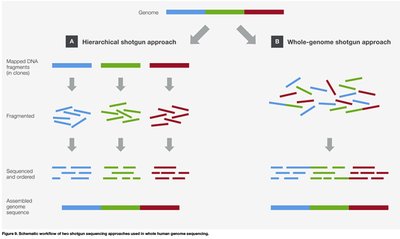
Image description: Diagram comparing hierarchical shotgun and whole-genome shotgun sequencing approaches. Hierarchical shotgun involves mapping DNA fragments before sequencing, while whole-genome shotgun fragments and sequences the entire genome without prior mapping. Both methods ultimately assemble the genome from overlapping sequence reads.
Economic Impact of the Human Genome Project
The U.S. government invested $14.5 billion in the Human Genome Project, resulting in significant economic benefits:
$965 billion in economic impact
$293 billion in total personal income
$169 billion increase in economic output since 2010

Image description: Infographic summarizing the economic impact of the Human Genome Project, including investment, personal income, and economic output.
Primer Design for DNA Sequencing and PCR
Primer Design Principles
Primers are short, single-stranded DNA sequences used to initiate DNA synthesis in sequencing and PCR. Proper primer design is crucial for specificity and efficiency.
Length: Primers are typically 18–24 nucleotides long.
GC Content: Optimal GC content is 40–50%. Avoid long stretches of a single base to prevent nonspecific binding.
Melting Temperature (Tm): Tm should be between 50–65°C. Forward and reverse primers should have similar Tm values. G and C bases contribute more to Tm than A and T.
Wallace Rule:
GC Clamp: Having 1–2 GC pairs at the 3' end increases primer stability.
Notation: Always write and report primers in the 5'→3' direction.
Primer Example and Notation
Example DNA sequence and primer design:
DNA Sequence: 5’ ATGCGTACGCTAGCTAGCTAGCATGCATGCATGCATGCATGCATGCATGC 3’
Forward Primer: 5’ ATCGCTAGCTAGCTAGCTAGCATGC 3’
Reverse Primer: 5’ GCTAGCATGCATGCATGCATGCAT 3’
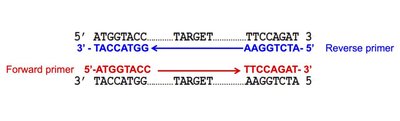
Image description: Diagram illustrating the binding of forward and reverse primers to a DNA sequence, with arrows indicating the direction of synthesis.
Primer Design Steps
Identify the target DNA sequence.
Design forward primer to match the 5' end of the target.
Design reverse primer to complement the 3' end of the target, written in 5'→3' notation.
Check primer properties: length, GC content, Tm, and GC clamp.
Summary Table: Primer Design Considerations
Criterion | Recommended Value | Purpose |
|---|---|---|
Length | 18–24 nucleotides | Ensures specificity and efficient binding |
GC Content | 40–50% | Optimal binding strength |
Melting Temperature (Tm) | 50–65°C | Facilitates proper annealing |
GC Clamp | 1–2 GC pairs at 3' end | Stabilizes primer binding |
Notation | 5'→3' | Standard reporting format |
Additional info:
These notes cover key concepts from the "Genomes and Genomics" and "Molecular Genetic Tools" chapters, including DNA sequencing technologies, primer design, and the economic impact of genomics. The included images directly illustrate sequencing approaches, primer binding, and the economic significance of the Human Genome Project.
