 Back
BackGenetic Imprinting and Allele Expression in a Pedigree
Study Guide - Smart Notes
 Tailored notes based on your materials, expanded with key definitions, examples, and context.
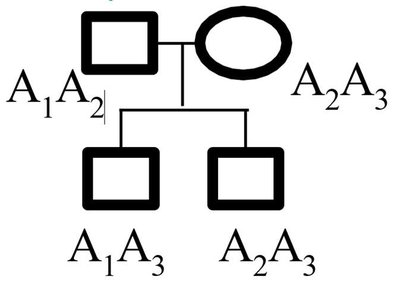
Q1. Gene A is a maternally imprinted gene. There are 3 known alleles: A1, A2, and A3. Consider this family pedigree. Which alleles will be expressed in Generation II?
Background
Topic: Genomic Imprinting and Pedigree Analysis
This question tests your understanding of genomic imprinting, specifically maternal imprinting, and how to interpret a pedigree to determine which alleles are expressed in the offspring.
Key Terms and Concepts:
Genomic Imprinting: An epigenetic phenomenon where only one allele of a gene is expressed, depending on the parent of origin.
Maternal Imprinting: The allele inherited from the mother is silenced (not expressed), so only the paternal allele is expressed.
Pedigree Analysis: A diagram that shows the inheritance of alleles through generations.
Step-by-Step Guidance
Identify the alleles each parent carries. The father has alleles A1 and A2, and the mother has alleles A2 and A3.
Determine the possible allele combinations for the children (Generation II) based on Mendelian inheritance. The children can inherit one allele from each parent, resulting in the genotypes shown in the pedigree: one child is A1A3, the other is A2A3.
Recall that with maternal imprinting, the allele inherited from the mother is silenced. Only the allele inherited from the father will be expressed in each child.
For each child, identify which allele came from the father and which from the mother. For example, in the child with genotype A1A3, A1 must have come from the father and A3 from the mother.
Try solving on your own before revealing the answer!
Final Answer:
In II-1 (A1A3), A1 will be expressed; in II-2 (A2A3), A2 will be expressed.
This is because the maternally inherited allele is imprinted (silenced), so only the paternally inherited allele is expressed in each child.
