 Back
BackGenetics Exam 2 Study Guide – Step-by-Step Guidance
Study Guide - Smart Notes
 Tailored notes based on your materials, expanded with key definitions, examples, and context.
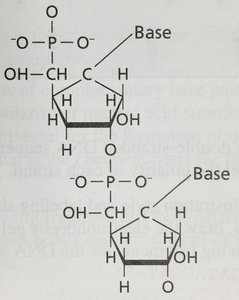
Q1. (Module 6, Q25) Identify five mistakes in this diagram of two linked DNA nucleotides.
Background
Topic: DNA Structure
This question tests your understanding of the chemical structure of DNA, specifically how nucleotides are linked together in a DNA strand. You are asked to critically analyze a diagram and identify structural errors.
Key Terms and Concepts:
Nucleotide: The basic building block of DNA, consisting of a phosphate group, deoxyribose sugar, and a nitrogenous base.
Phosphodiester bond: The covalent bond that links the 3' carbon of one sugar to the 5' phosphate of the next nucleotide.
Base attachment: Nitrogenous bases attach to the 1' carbon of the sugar.
Directionality: DNA strands have a 5' to 3' orientation.
Step-by-Step Guidance
Examine the sugar-phosphate backbone. Check if the phosphodiester bonds are correctly linking the 3' carbon of one sugar to the 5' phosphate of the next.
Look at the attachment points for the nitrogenous bases. Confirm that each base is attached to the 1' carbon of the sugar.
Check the orientation of the sugars. The deoxyribose sugars should be oriented so that the 5' and 3' carbons are in the correct positions relative to the backbone.
Verify the number of phosphate groups between nucleotides. There should be a single phosphate group linking two nucleotides in a DNA strand (not a triphosphate).
Look for any extra or missing atoms/groups (e.g., missing hydrogens, incorrect hydroxyl groups, or misplaced oxygen atoms).
Try solving on your own before revealing the answer!
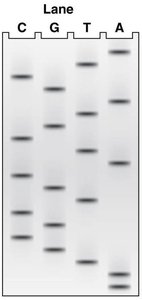
Q2. (Module 7, Q17) From the (Sanger sequencing) autoradiograph below, give the sequence and directionality of the sequenced DNA molecule. Explain the role of di-deoxynucleotides in the banding patterns on this gel/autoradiograph.
Background
Topic: DNA Sequencing (Sanger Method)
This question tests your ability to interpret a Sanger sequencing gel and understand how chain-terminating nucleotides (ddNTPs) are used to determine DNA sequence.
Key Terms and Concepts:
Sanger sequencing: A method for determining the nucleotide sequence of DNA using chain-terminating dideoxynucleotides (ddNTPs).
Autoradiograph: An image of a gel showing DNA fragments separated by size.
ddNTPs: Modified nucleotides that lack a 3' OH group, causing chain termination when incorporated.
Step-by-Step Guidance
Start reading the gel from the bottom (smallest fragments) to the top (largest fragments). Each band represents a DNA fragment ending with a specific ddNTP.
For each lane (C, G, T, A), note the order of bands from bottom to top. This gives you the sequence in the 5' to 3' direction of the newly synthesized strand.
Write out the sequence by recording the base corresponding to each band as you move up the gel.
Remember that the sequence you read is complementary to the template strand used in the reaction.
Explain that ddNTPs cause chain termination because they lack a 3' OH group, preventing further extension of the DNA strand. This results in fragments of varying lengths, each ending at a specific nucleotide.
Try solving on your own before revealing the answer!
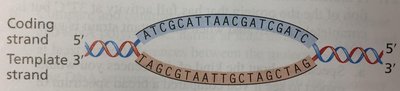
Q3. (Module 8, Q16) Below is an illustration of a portion of a gene that is being transcribed. The coding strand and template strand, as well as their directionality, are labelled. For the sequence shown, answer the following questions:
a. Superimpose a drawing of RNA polymerase as it nears the end of transcription of the DNA sequence.
b. Indicate the direction in which RNA polymerase moves as it transcribes this gene.
c. Write the polarity and sequence of the RNA transcript from the DNA sequence given.
d. Identify the direction in which the promoter for this gene is located.
Background
Topic: Transcription and Gene Structure
This question tests your understanding of how transcription occurs, the roles of the coding and template strands, and how to determine the direction of transcription and the resulting RNA sequence.
Key Terms and Concepts:
Coding strand: The DNA strand with the same sequence as the RNA transcript (except T for U).
Template strand: The DNA strand used by RNA polymerase to synthesize RNA.
RNA polymerase: The enzyme that synthesizes RNA from the DNA template.
Promoter: The DNA sequence where RNA polymerase binds to initiate transcription.
Step-by-Step Guidance
Identify the 5' and 3' ends of both the coding and template strands as shown in the diagram.
Recall that RNA polymerase moves along the template strand in the 3' to 5' direction, synthesizing RNA in the 5' to 3' direction.
Determine the sequence of the RNA transcript by copying the coding strand sequence, replacing T with U.
Locate the promoter region, which is upstream (toward the 5' end) of the coding region on the coding strand.
Try solving on your own before revealing the answer!
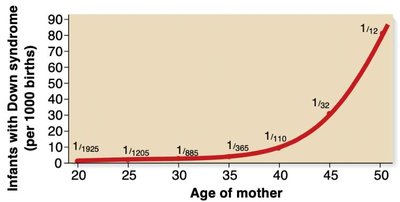
Q4. (Module 11, Q3) In the chart below, what important trend related to aneuploidy do the data support?
Background
Topic: Aneuploidy and Chromosome Aberrations
This question asks you to interpret a graph showing the relationship between maternal age and the incidence of Down syndrome (trisomy 21) in infants. It tests your ability to analyze data and understand the genetic basis of aneuploidy.
Key Terms and Concepts:
Aneuploidy: The presence of an abnormal number of chromosomes in a cell.
Down syndrome: A genetic disorder caused by trisomy 21.
Maternal age effect: The increased risk of chromosomal abnormalities with increasing maternal age.
Step-by-Step Guidance
Examine the x-axis (age of mother) and y-axis (incidence of Down syndrome per 1000 births) of the graph.
Observe how the incidence of Down syndrome changes as maternal age increases.
Note the specific ratios provided at different ages and how the curve steepens with age.
Think about the biological reasons why aneuploidy risk increases with maternal age (e.g., nondisjunction during meiosis).
Try solving on your own before revealing the answer!
