 Back
BackGenetics Homework Study Guide: Pathways, Gene Structure, DNA Replication, and Inheritance
Study Guide - Smart Notes
 Tailored notes based on your materials, expanded with key definitions, examples, and context.
Q1. Growth of Neurospora Strains on Serine Biosynthesis Intermediates
Background
Topic: Metabolic Pathways & One-Gene-One-Enzyme Hypothesis
This question explores how mutations in different enzymes of the serine biosynthesis pathway affect the ability of Neurospora to grow when provided with various pathway intermediates. It is based on the classic experiments by Beadle and Tatum.

Key Terms and Concepts:
Metabolic pathway: A series of chemical reactions in a cell, each catalyzed by a specific enzyme.
Auxotroph: An organism that cannot synthesize a particular compound required for its growth.
One-gene-one-enzyme hypothesis: Each gene encodes a single enzyme that affects a step in a metabolic pathway.
Step-by-Step Guidance
Examine the pathway diagram. Note the order of intermediates and which enzyme catalyzes each step.
For each mutant (Enzyme 1, 2, or 3), determine which step is blocked and which intermediates can bypass the block if supplied externally.
Fill in the table by predicting growth (+) or no growth (–) for each strain on each substrate, based on whether the block can be bypassed.
For part (b), consider what would happen if all three enzymes were encoded by a single gene. Think about the effect of a loss-of-function mutation in that gene.
Try solving on your own before revealing the answer!
Q2. Diagram of a Monocistronic Bacterial Protein-Coding Gene
Background
Topic: Gene Structure & Expression in Prokaryotes
This question asks you to draw and label the key features of a bacterial gene, including regulatory and coding regions, and to distinguish between transcribed and translated regions.
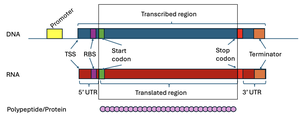
Key Terms and Elements:
Promoter: DNA sequence where RNA polymerase binds to initiate transcription.
Transcription Start Site (TSS): The location where transcription begins.
Ribosome Binding Site (RBS): Sequence on mRNA where ribosome binds to start translation.
Start/Stop Codon: Codons that signal the beginning and end of translation.
Terminator: Sequence signaling the end of transcription.
UTRs (Untranslated Regions): Regions of mRNA not translated into protein.
Step-by-Step Guidance
Draw a DNA segment and label the promoter, TSS, RBS, start codon, stop codon, and terminator in the correct order.
Indicate the transcribed region (from TSS to terminator) and the translated region (from start to stop codon).
Show the corresponding mRNA, labeling the 5' and 3' UTRs, and indicate which regions are translated.
Box the translated regions on both DNA and RNA to clearly distinguish them from untranslated regions.
Try drawing and labeling your diagram before checking the example!
Q3. Meselson and Stahl Experiment: DNA Replication Models
Background
Topic: DNA Replication Mechanisms
This question tests your understanding of the experimental evidence distinguishing between conservative, semi-conservative, and discontinuous models of DNA replication.
Key Terms and Concepts:
Conservative replication: Parental DNA remains intact; new DNA is entirely new.
Semi-conservative replication: Each new DNA molecule has one old and one new strand.
Discontinuous replication: Hypothetical model where DNA is copied in segments with mixed old and new material.
Cesium-chloride gradient: Technique to separate DNA by density (N15 vs N14).
Step-by-Step Guidance
Review the expected banding patterns for each replication model after multiple generations in the experiment.
Compare the observed result (two bands: pure N14 and pure N15) to the predictions for each model.
For each model, explain whether the result supports or rules it out, and why.
Be sure to justify your reasoning based on how DNA strands are distributed in each model.
Try explaining your reasoning for each model before checking the explanations!
Q4. Lagging Strand Synthesis and Okazaki Fragments
Background
Topic: DNA Replication – Lagging Strand Synthesis
This question focuses on the order of Okazaki fragment synthesis and the role of DNA ligase in sealing nicks in the DNA backbone.
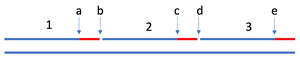
Key Terms and Concepts:
Okazaki fragments: Short DNA segments synthesized on the lagging strand.
RNA primer: Short RNA sequence that provides a starting point for DNA synthesis.
DNA ligase: Enzyme that seals nicks in the DNA backbone after RNA primers are removed and replaced with DNA.
Step-by-Step Guidance
Determine the direction of lagging strand synthesis and the order in which fragments are made.
Identify which fragment (1, 2, or 3) was synthesized first based on primer placement and DNA extension.
For the ligase question, locate the positions (a–e) where DNA ligase will act after RNA primers are removed and gaps are filled.
Explain why ligase does not seal the junctions between RNA and DNA, but only between DNA fragments.
Try reasoning through the synthesis order and ligase action before checking the solution!
Q5. Inheritance and Molecular Analysis of BRCA-1 Mutation
Background
Topic: Human Genetics, Pedigree Analysis, and Molecular Genetics
This question involves interpreting a pedigree and molecular data (PCR, Northern, and Western blots) to determine the inheritance pattern and molecular nature of a BRCA-1 mutation.
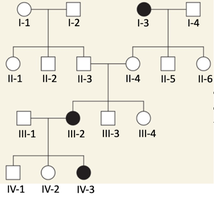
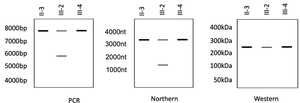
Key Terms and Concepts:
Pedigree: Diagram showing inheritance of traits in a family.
Autosomal dominant/recessive: Patterns of inheritance for genes on autosomes.
PCR, Northern, Western blot: Techniques to analyze DNA, RNA, and protein, respectively.
Deletion mutation: Mutation where a segment of DNA is missing.
Heterozygous/homozygous: Having two different or two identical alleles at a gene locus.
Penetrance: Proportion of individuals with a mutation who show the phenotype.
Step-by-Step Guidance
Analyze the pedigree to determine if the mutation appears dominant or recessive based on affected/unaffected individuals in each generation.
Interpret the PCR, Northern, and Western blot results to determine how the mutation affects DNA, RNA, and protein.
Use the band patterns to infer whether affected individuals are heterozygous or homozygous for the mutation.
Relate your findings to the concepts of dominance, recessiveness, and penetrance, and consider how these affect the risk of cancer in the family.
Try analyzing the pedigree and molecular data before checking the full explanation!
