 Back
Transcription and RNA Processing: From DNA to Functional RNA
Study Guide - Smart Notes
 Tailored notes based on your materials, expanded with key definitions, examples, and context.
Transcription and RNA Processing
Introduction: The Flow of Genetic Information
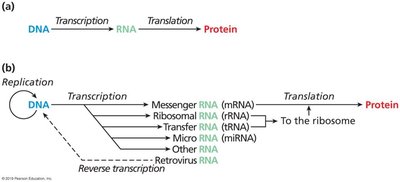
Genetic information is stored in DNA and must be accurately expressed to produce functional molecules. This process involves the regulated transcription of DNA into RNA, followed by RNA processing to yield mature, functional RNA species. The central dogma of molecular biology describes the directional flow of genetic information from DNA to RNA to protein, with some exceptions such as reverse transcription in retroviruses.
Storage of Information: DNA contains the genetic blueprint for all cellular functions.
Copying Information: DNA replication ensures accurate transmission of genetic material.
Generating Variation: Mutations introduce genetic diversity.
Using Information: Gene expression is tightly regulated to ensure proper cellular function.
The Central Dogma and Its Refinements
The central dogma, first articulated by Francis Crick, states that genetic information flows from DNA to RNA (transcription) and from RNA to protein (translation). However, not all genes encode proteins; many produce functional RNAs, and some information can flow from RNA back to DNA (reverse transcription).
Transcription: DNA is transcribed into various RNA types, including mRNA, rRNA, tRNA, and regulatory RNAs.
Translation: mRNA is translated into protein by ribosomes.
Reverse Transcription: Retroviruses can convert RNA back into DNA.
RNA: Structure, Chemistry, and Function
RNA Chemistry and Structure
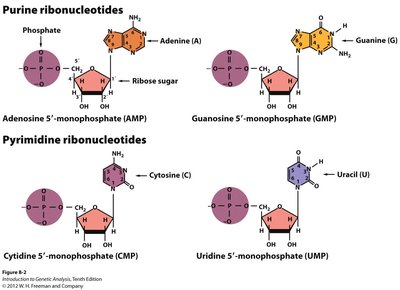
RNA is chemically distinct from DNA, featuring a ribose sugar with a 2'-OH group and the base uracil (U) instead of thymine (T). RNA is usually single-stranded but can form complex secondary and tertiary structures through intramolecular base pairing.
Ribose Sugar: The presence of a 2'-OH group makes RNA more susceptible to hydrolysis.
Bases: RNA contains adenine (A), guanine (G), cytosine (C), and uracil (U).
Single-Stranded Nature: Allows RNA to fold into diverse structures, enabling catalytic and regulatory functions.
Major Types of Cellular RNA
Cells contain several classes of RNA, each with distinct roles:
mRNA (messenger RNA): Encodes protein sequences.
rRNA (ribosomal RNA): Structural and catalytic component of ribosomes.
tRNA (transfer RNA): Adaptor molecule for translation.
snRNA (small nuclear RNA): Involved in pre-mRNA splicing.
miRNA/siRNA (micro/small interfering RNA): Regulate gene expression.
Other RNAs: Include snoRNA (rRNA processing), telomerase RNA, and more.
Gene Expression in Prokaryotes and Eukaryotes
Prokaryotic vs. Eukaryotic Gene Expression
Gene expression differs fundamentally between prokaryotes and eukaryotes, primarily due to cellular compartmentalization in eukaryotes.
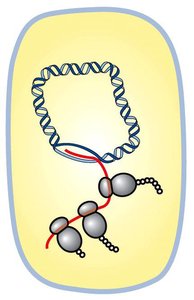
Prokaryotes: Transcription and translation are coupled; both occur in the cytoplasm.
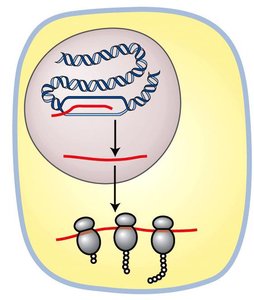
Eukaryotes: Transcription occurs in the nucleus, and RNA processing precedes export and translation in the cytoplasm.
Transcription: Mechanism and Regulation
Transcription Initiation in Prokaryotes
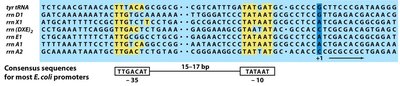
Transcription in prokaryotes begins when RNA polymerase holoenzyme binds to promoter sequences, typically at the -35 and -10 regions relative to the transcription start site (+1). The sigma (σ) factor confers promoter specificity.
Promoter Elements: Consensus sequences at -35 (TTGACA) and -10 (TATAAT) positions.
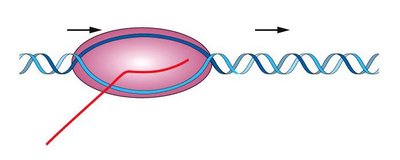
Initiation: RNA polymerase unwinds DNA and begins RNA synthesis at +1.
Elongation: After promoter escape, the core enzyme synthesizes RNA 5' to 3'.
Transcription Initiation in Eukaryotes
Eukaryotic transcription is more complex, involving three major RNA polymerases and multiple general transcription factors (GTFs). RNA polymerase II transcribes protein-coding genes and requires assembly of a preinitiation complex at the promoter, often involving a TATA box.
RNA Polymerase II: Main enzyme for mRNA synthesis.
General Transcription Factors: TFIID (with TBP), TFIIB, TFIIE, TFIIF, TFIIH, etc.
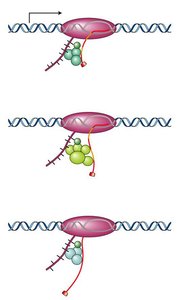
Promoter Escape: Phosphorylation of the C-terminal domain (CTD) of Pol II triggers transition to elongation.
Transcription Elongation and Termination
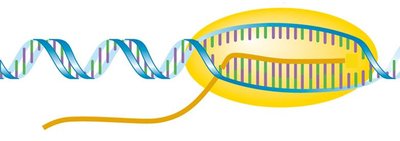
During elongation, RNA polymerase synthesizes RNA in the 5' to 3' direction, reading the DNA template 3' to 5'. Termination mechanisms differ between prokaryotes and eukaryotes.
Prokaryotes: Intrinsic (Rho-independent) and Rho-dependent termination mechanisms.
Eukaryotes: Cleavage and polyadenylation signals direct 3' end formation; RNA Pol II is released after downstream degradation of the transcript.
RNA Processing in Eukaryotes
Overview of RNA Processing
Eukaryotic pre-mRNA undergoes several processing steps before becoming mature mRNA:
5' Capping: Addition of a 7-methylguanosine cap early during transcription.
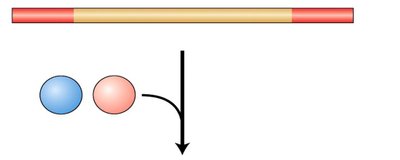
Splicing: Removal of introns and joining of exons by the spliceosome.
3' Polyadenylation: Addition of a poly(A) tail after cleavage at the polyadenylation signal.
Splicing and the Spliceosome
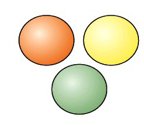
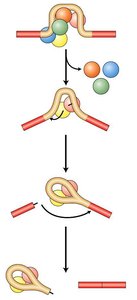
Splicing is catalyzed by the spliceosome, a dynamic complex of snRNAs and proteins (snRNPs). Splicing occurs via two transesterification reactions, removing introns as lariats and ligating exons.
Key Sequence Elements: 5' splice site (GU), branch-point A, 3' splice site (AG).
Major snRNPs: U1, U2, U4/U6, U5.
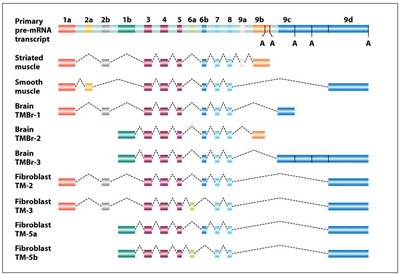
Alternative Splicing: Allows a single gene to produce multiple mRNA and protein isoforms.
Mitochondrial Transcription
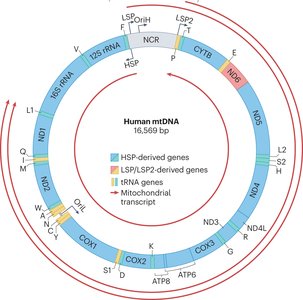
Processing of Mitochondrial Transcripts
Mitochondrial DNA is transcribed into long polycistronic RNAs, which are then processed to release individual mRNAs, rRNAs, and tRNAs. This organization reflects the compact and efficient nature of the mitochondrial genome.
Summary Table: Major Types of Cellular RNA
RNA Type | Size (nt) | Types/Cell | Abundance | Major Function |
|---|---|---|---|---|
mRNA | 100s–1000s | 1000s | Variable | Codes for protein |
rRNA | 100–5300 | 3 | Very high | Component of ribosome |
snoRNA | 60–400 | 10–100 | Low to moderate | rRNA processing |
snRNA | 100–300 | 5 | Moderate | Component of spliceosome |
tRNA | 75–90 | 40–60 | High | Protein synthesis |
miRNA/siRNA | 22 | ? | ? | Gene regulation |
Key Equations and Concepts
Direction of Synthesis: RNA is synthesized 5' to 3'; the DNA template is read 3' to 5'.
Transcription Reaction:
Splicing Reactions: Two sequential transesterification reactions join exons and remove introns as lariats.
Practice Questions
Which features distinguish transcription from replication in eukaryotes?
Label processes as exclusive to prokaryotes, eukaryotes, both, or neither (e.g., sigma factor binding, alternative splicing, capping, etc.).
