 Back
Transcription and RNA Processing: Mechanisms and Regulation
Study Guide - Smart Notes
 Tailored notes based on your materials, expanded with key definitions, examples, and context.
Transcription: The Central Dogma of Molecular Biology
Overview of Genetic Information Flow
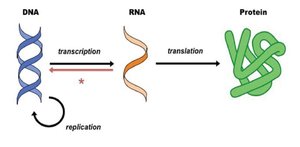
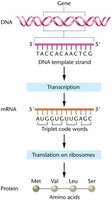
The central dogma describes the flow of genetic information from DNA to RNA to protein. Transcription is the process by which RNA is synthesized from a DNA template, and translation is the subsequent process where proteins are synthesized from RNA.
Transcription: DNA is used as a template to produce RNA.
Translation: RNA is decoded to synthesize proteins.
Replication: DNA is copied to produce more DNA.
Coding information: Read in non-overlapping three-nucleotide codons.
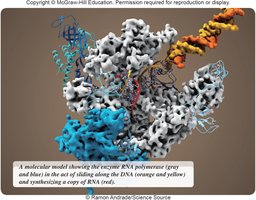
Mechanism of Transcription
Key Components of Transcription
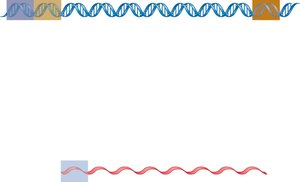
Transcription involves several DNA and RNA elements that regulate and facilitate the process. The DNA template strand is used to synthesize a complementary RNA strand, while the coding strand has the same sequence as the RNA (except T is replaced by U).
Regulatory sequences: Sites for binding regulatory proteins that influence transcription rate.
Promoter: Site for RNA polymerase binding; directs initiation of transcription.
Terminator: Signals the end of transcription.
Ribosome-binding site: Site for ribosome binding on mRNA; translation begins near this site.
Start codon: Specifies the first amino acid in a polypeptide sequence.
Codons: Three-nucleotide sequences in mRNA specifying amino acids.
Stop codon: Specifies the end of polypeptide synthesis.
Polycistronic mRNA: In bacteria, a single mRNA may encode multiple polypeptides.
Stages of Transcription
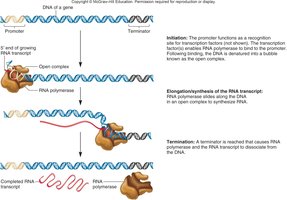
Transcription occurs in three main stages: initiation, elongation, and termination.
Initiation: RNA polymerase binds to the promoter, forming a closed complex. The DNA unwinds to form an open complex, and RNA synthesis begins.
Elongation: RNA polymerase slides along the DNA, synthesizing RNA in the 5' to 3' direction. The template strand is read in the 3' to 5' direction.
Termination: RNA synthesis ends, and the newly made RNA and RNA polymerase are released.
Transcription in Bacteria
RNA Polymerase Structure and Function
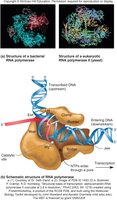
Bacterial RNA polymerase is a multi-subunit enzyme responsible for synthesizing RNA from a DNA template. It does not require a primer and uses ribonucleotides as substrates.
Core enzyme: Five subunits (α2ββ'ω) responsible for RNA synthesis.
Sigma factor: One subunit (σ) required for promoter recognition.
Promoters and Consensus Sequences
Promoters are DNA sequences that direct the exact location for transcription initiation. E. coli promoters have two consensus sequences: TTGACA (−35 region) and TATAAT (−10 region, Pribnow box).
Consensus sequences: Homologous DNA sequences found in different genes.
Promoter numbering: Bases are numbered relative to the transcription start site (+1).
Cis-acting and Trans-acting Elements
Cis-acting elements are DNA sequences located on the same molecule as the gene they regulate. Trans-acting factors are proteins that bind to cis-acting elements to influence gene expression.
Cis-acting elements: Often adjacent to the gene.
Trans-acting factors: Example: sigma factor.
Initiation, Elongation, and Termination in Bacteria
Initiation relies on RNA polymerase binding to the promoter. Elongation involves the synthesis of RNA, and termination releases the RNA and polymerase.
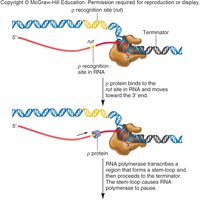
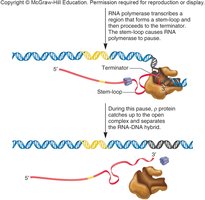
Rho-dependent termination: Requires the rho protein.
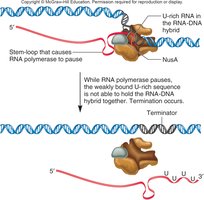
Rho-independent termination: Does not require rho; involves a stem-loop structure and a uracil-rich sequence.
Transcription in Eukaryotes
Complexity and Regulation
Eukaryotic transcription is more complex due to larger genomes, cellular complexity, and multicellularity. Regulation ensures genes are expressed only in the right cells at the right time.
Three RNA polymerases: RNA pol I (rRNA), RNA pol II (protein-coding genes), RNA pol III (tRNA, 5S rRNA).
Core promoter: Includes the TATA box and transcriptional start site.
Proximal-promoter elements, enhancers, silencers: Regulatory DNA elements.
Transcription factors: General (GTFs) and regulatory (activators, repressors).

Initiation of Transcription in Eukaryotes
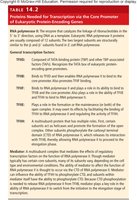
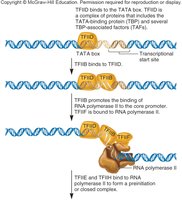
Initiation involves the assembly of the basal transcription apparatus, including RNA pol II and five GTFs. TFIID binds to the TATA box, followed by other factors and RNA pol II.
TFIID: Binds to TATA box.
TFIIB: Promotes RNA pol II binding.
TFIIF, TFIIE, TFIIH: Additional factors for preinitiation complex formation.
mRNA Modification in Eukaryotes
Poly-A Tail Addition
The poly-A tail is a string of adenine nucleotides added to the 3' end of mature mRNA. It is not encoded in the gene sequence and is added enzymatically after transcription.
Polyadenylation signal sequence: AAUAAA.
Function: Important for mRNA stability and translation.

5' Cap Addition
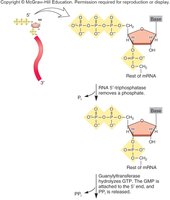
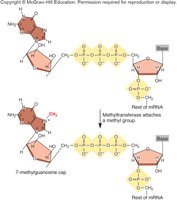
Most mature mRNAs have a 7-methyl guanosine cap attached at their 5' end. Capping occurs as pre-mRNA is being synthesized by RNA pol II.
Function: Cap-binding proteins facilitate RNA export, translation, and splicing.
Splicing and the Spliceosome
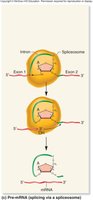
Splicing removes introns from pre-mRNA and joins exons to produce mature mRNA. The spliceosome, composed of snRNPs, catalyzes this process.
Introns: Non-coding regions spliced out.
Exons: Coding regions joined together.
Alternative splicing: Generates different mRNAs from the same pre-mRNA.
RNA Editing
RNA editing is a posttranscriptional process where nucleotides are inserted, deleted, or substituted. It is prevalent in mitochondrial and chloroplast RNAs in plants.
Comparison of Transcription and RNA Modification in Bacteria and Eukaryotes
Key Differences
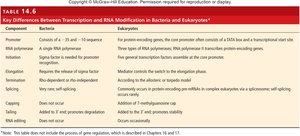
Bacterial and eukaryotic transcription differ in promoter structure, initiation, elongation, termination, splicing, capping, and polyadenylation.
Component | Bacteria | Eukaryotes |
|---|---|---|
Promoter | −35 and −10 sequences | TATA box and transcriptional start site |
Initiation | Sigma factor required | GTFs required |
Elongation | Simple | Complex, regulated |
Termination | Rho-dependent/independent | Polyadenylation signal, cleavage |
Splicing | Rare | Common, spliceosome |
Capping | Absent | 7-methyl guanosine cap |
Polyadenylation | Absent | Poly-A tail added |
Summary
Transcription is a fundamental process in genetics, converting DNA information into RNA, which is then translated into proteins. The mechanisms and regulation of transcription differ between bacteria and eukaryotes, with eukaryotes exhibiting greater complexity and posttranscriptional modifications such as capping, polyadenylation, and splicing.
