Two true-breeding pea plants are crossed. One parent is round, terminal, violet, constricted, while the other expresses the contrasting phenotypes of wrinkled, axial, white, full. The four pairs of contrasting traits are controlled by four genes, each located on a separate chromosome. In the F1 generation, only round, axial, violet, and full are expressed. In the F2 generation, all possible combinations of these traits are expressed in ratios consistent with Mendelian inheritance. Which phenotype appears most frequently in the F2 results? Write a mathematical expression that predicts the frequency of occurrence of this phenotype.
Verified step by step guidance
1
Identify the dominant and recessive alleles for each trait based on the F1 phenotype. Since the F1 generation shows round, axial, violet, and full phenotypes, these are the dominant traits, and wrinkled, terminal, white, and constricted are recessive.
Assign symbols to each gene, for example: R (round) is dominant over r (wrinkled), A (axial) over a (terminal), V (violet) over v (white), and F (full) over f (constricted). The true-breeding parents would be RR AA VV FF (round, terminal, violet, constricted) and rr aa vv ff (wrinkled, axial, white, full).
Determine the genotype of the F1 generation by crossing the two true-breeding parents. The F1 genotype will be heterozygous for all traits: Rr Aa Vv Ff, expressing all dominant phenotypes.
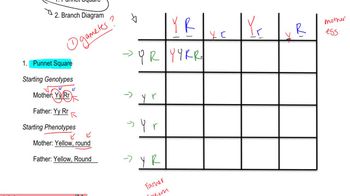
Understand that the F2 generation results from self-crossing the F1 individuals (Rr Aa Vv Ff × Rr Aa Vv Ff). Each gene segregates independently according to Mendel's law of independent assortment.
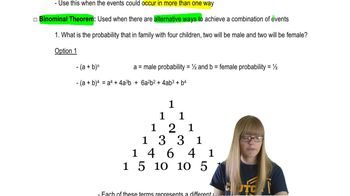
Calculate the frequency of the most common phenotype in the F2 generation, which is the phenotype expressing all dominant traits (round, axial, violet, full). For each gene, the probability of the dominant phenotype is \$\(\frac{3}{4}\)\$ (since 1/4 are homozygous recessive and 3/4 show the dominant phenotype). Therefore, the overall frequency is the product of the probabilities for all four traits: \$\(\left\)(\(\frac{3}{4}\)\(\right\))^4\$.
Key Concepts
Here are the essential concepts you must grasp in order to answer the question correctly.
Mendelian Inheritance and Dominance
Mendelian inheritance describes how traits are passed from parents to offspring through dominant and recessive alleles. In this question, each trait has two contrasting forms controlled by separate genes, with dominant alleles expressed in the F1 generation. Understanding dominance helps predict which phenotypes appear in offspring.
A multihybrid cross involves multiple gene pairs segregating independently, as seen with four gene pairs here. The F2 generation results from self-crossing F1 heterozygotes, producing phenotypic ratios based on independent assortment. Calculating combined probabilities for multiple traits requires multiplying individual trait ratios.
Phenotypic ratios in the F2 generation follow Mendel’s laws, typically 3:1 for single traits with complete dominance. For multiple traits, the overall frequency of a phenotype is the product of individual trait probabilities. This allows prediction of the most frequent phenotype and its expected frequency mathematically.

 Verified step by step guidance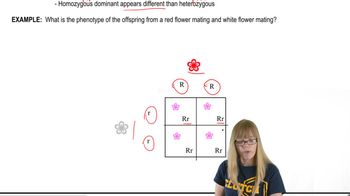
 04:37
04:37