Pearson+ LogoPearson+ Logo
Ch. 8 - Genetic Analysis and Mapping in Bacteria and Bacteriophages
Klug - Essentials of Genetics 10th Edition
Klug10th EditionEssentials of GeneticsISBN: 9780135588789Not the one you use?Change textbook
Chapter 8, Problem 8

Describe the origin of F' bacteria and merozygotes.

Verified step by step guidance
1
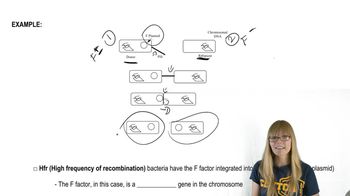
Understand that F' (F prime) bacteria originate from an F factor (fertility factor) that has excised incorrectly from the bacterial chromosome, capturing some adjacent chromosomal genes along with the F plasmid.
Recognize that this excision event creates an F' plasmid, which carries both the fertility genes and some bacterial chromosomal genes, allowing the F' bacteria to transfer these chromosomal genes during conjugation.
Define merozygotes as partial diploid bacterial cells formed when an F' bacterium conjugates with an F- bacterium, transferring the F' plasmid and thus introducing an extra copy of certain chromosomal genes into the recipient.
Note that merozygotes contain one copy of the chromosomal genes on the bacterial chromosome and an additional copy on the F' plasmid, which can be used to study gene function and complementation.
Summarize that the origin of F' bacteria is due to aberrant excision of the F factor capturing chromosomal genes, and merozygotes result from conjugation involving F' bacteria, leading to partial diploidy.

Verified video answer for a similar problem:

This video solution was recommended by our tutors as helpful for the problem above.
Video duration:
2m
Was this helpful?

Key Concepts

Here are the essential concepts you must grasp in order to answer the question correctly.

F' (F-prime) Bacteria

F' bacteria are formed when an F plasmid excises incorrectly from the bacterial chromosome, carrying with it some chromosomal genes. This results in a plasmid that contains both F factor genes and additional bacterial genes, enabling the transfer of these genes during conjugation.
Recommended video:
Guided course
08:52
F Factor and Hfr

Merozygotes

Merozygotes are partial diploid bacterial cells formed when an F' plasmid transfers chromosomal genes to a recipient cell. They contain two copies of certain genes—one on the chromosome and one on the F' plasmid—allowing the study of gene function and complementation.

Conjugation and Plasmid Excision

Conjugation is the process by which genetic material is transferred between bacteria via direct contact. During this process, the F plasmid can excise from the chromosome, sometimes inaccurately, leading to the formation of F' plasmids that carry extra chromosomal genes.
Recommended video: