The bacteriophage genome consists of many genes encoding proteins that make up the head, collar, tail, and tail fibers. When these genes are transcribed following phage infection, how are these proteins synthesized, since the phage genome lacks genes essential to ribosome structure?
Verified step by step guidance
1
Understand that bacteriophages are viruses that infect bacteria and rely on the host's cellular machinery to reproduce.
Recognize that although the phage genome encodes proteins for its structure (head, collar, tail, tail fibers), it does not encode ribosomal RNA or ribosomal proteins, which are essential components of ribosomes.
Recall that ribosomes are the molecular machines responsible for translating mRNA into proteins, and these are provided by the bacterial host cell.
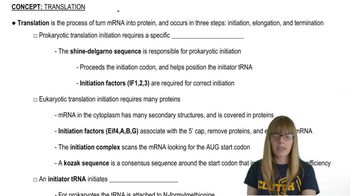
Conclude that after the phage injects its genome into the bacterial host, the host's ribosomes translate the phage mRNAs into phage proteins.
Therefore, the synthesis of phage structural proteins depends on the host bacterium's ribosomes and translation machinery, which the phage genome does not encode.
Verified video answer for a similar problem:
This video solution was recommended by our tutors as helpful for the problem above.
Video duration:
2m
Play a video:
Was this helpful?
Key Concepts
Here are the essential concepts you must grasp in order to answer the question correctly.
Bacteriophage Genome and Gene Encoding
Bacteriophages have genomes encoding structural proteins like head, collar, tail, and tail fibers. These genes provide instructions for making viral components but do not include genes for the host's cellular machinery, such as ribosomes.
Viruses, including bacteriophages, rely on the host cell's molecular machinery to replicate and produce proteins. Since phages lack ribosomal genes, they hijack the host bacterium's ribosomes and enzymes to translate their mRNA into proteins.
After infection, phage DNA is transcribed into mRNA using host RNA polymerase. This mRNA is then translated by host ribosomes into viral proteins, enabling the assembly of new phage particles within the bacterial cell.