Textbook Question
Using the following amino acid sequences obtained from different species of apes, construct a phylogenetic tree of the apes.
526
views

 Sanders 3rd EditionCh. 1 - The Molecular Basis of Heredity, Variation, and EvolutionProblem 22a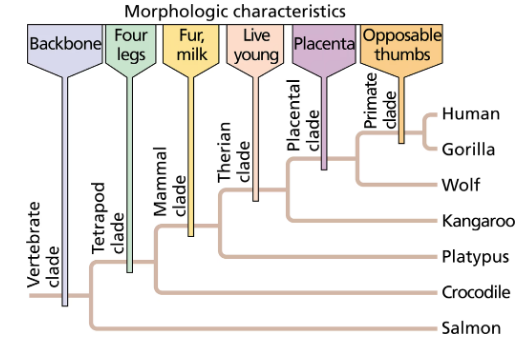
 Verified step by step guidance
 08:16
08:16 08:16 08:16
Using the following amino acid sequences obtained from different species of apes, construct a phylogenetic tree of the apes.
Examine the following figure and answer the following questions.
What characteristics are shared by the mammalian clade and the primate clade? What characteristic distinguishes the primates from other members of the mammalian clade?
The following segment of DNA is the template strand transcribed into mRNA:
5'-...GACATGGAA...-3'
What is the amino acid sequence produced by translation?
The following segment of DNA is the template strand transcribed into mRNA:
5'-...GACATGGAA...-3'
What is the sequence of mRNA created from this sequence?
Examine the following figure and answer the following questions.
What characteristic is shared by all clades in the figure?
Fill in the missing nucleotides (so there are three per block) and the missing amino acid abbreviations in the graphic shown here.