Pearson+ LogoPearson+ Logo
Ch. 1 - The Molecular Basis of Heredity, Variation, and Evolution
Sanders - Genetic Analysis: An Integrated Approach 3rd Edition
Sanders3rd EditionGenetic Analysis: An Integrated ApproachISBN: 9780135564172Not the one you use?Change textbook
Chapter 1, Problem 22b

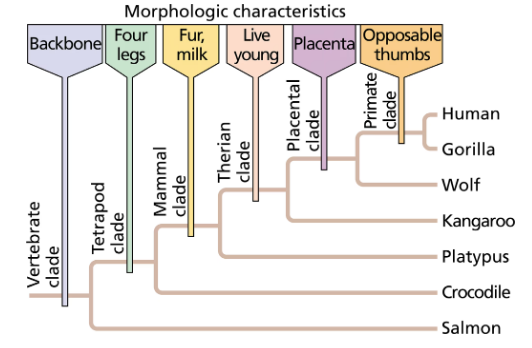
Examine the following figure and answer the following questions.
Phylogenetic tree illustrating shared morphologic characteristics among various animal clades, including vertebrates and primates.
What characteristic is shared by all clades in the figure?

Verified step by step guidance
1
Examine Figure 1.17 carefully to identify the clades represented in the figure. A clade is a group of organisms that includes a common ancestor and all its descendants.
Understand that a key characteristic of clades is that they are monophyletic, meaning they include an ancestor and all of its descendants, and no other organisms.
Look for shared derived characteristics (synapomorphies) in the figure. These are traits that are unique to a particular clade and distinguish it from other groups.
Determine if the figure highlights evolutionary relationships, such as branching patterns, which indicate common ancestry among the clades.
Conclude that the shared characteristic of all clades in the figure is their inclusion of a common ancestor and all its descendants, which is a fundamental principle of clade formation in phylogenetics.

Verified video answer for a similar problem:

This video solution was recommended by our tutors as helpful for the problem above.
Video duration:
3m
Was this helpful?

Key Concepts

Here are the essential concepts you must grasp in order to answer the question correctly.

Clades

A clade is a group of organisms that includes a common ancestor and all its descendants. Clades are fundamental in the study of phylogenetics, as they help illustrate evolutionary relationships. Understanding clades allows scientists to categorize species based on shared characteristics and evolutionary history.
Recommended video:
Guided course
08:16
Phylogenetic Trees

Phylogenetic Tree

A phylogenetic tree is a diagram that represents the evolutionary relationships among various biological species based on their genetic characteristics. Each branch point indicates a divergence from a common ancestor, and the arrangement of the tree reflects the evolutionary pathways. Analyzing a phylogenetic tree helps identify shared traits among clades.
Recommended video:
Guided course
08:16
Phylogenetic Trees

Shared Characteristics

Shared characteristics, or synapomorphies, are traits that are common to a group of organisms and are inherited from a common ancestor. These traits are crucial for defining clades and understanding evolutionary relationships. Identifying shared characteristics helps in determining how closely related different species are within a phylogenetic context.
Recommended video:
Guided course
09:46
Cancer Characteristics