Pearson+ LogoPearson+ Logo
Ch. 1 - The Molecular Basis of Heredity, Variation, and Evolution
Sanders - Genetic Analysis: An Integrated Approach 3rd Edition
Sanders3rd EditionGenetic Analysis: An Integrated ApproachISBN: 9780135564172Not the one you use?Change textbook
Chapter 1, Problem 22c

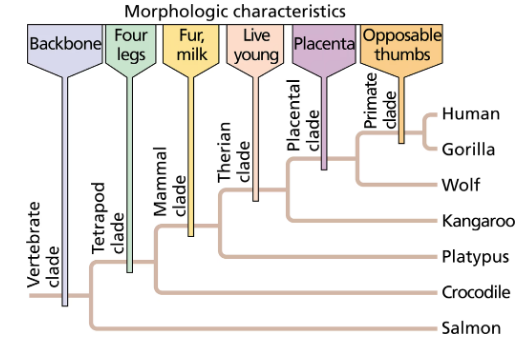
Examine the following figure and answer the following questions.
Diagram illustrating the evolutionary relationships and shared characteristics among vertebrate clades, including mammals and primates.
What characteristics are shared by the mammalian clade and the primate clade? What characteristic distinguishes the primates from other members of the mammalian clade?

Verified step by step guidance
1
Examine Figure 1.17 to identify the shared characteristics of the mammalian clade. Mammals typically share traits such as the presence of mammary glands, hair or fur, and endothermy (warm-bloodedness).
Next, identify the shared characteristics of the primate clade. Primates generally share traits such as forward-facing eyes, a large brain relative to body size, and grasping hands with opposable thumbs.
Compare the traits of the mammalian clade and the primate clade to determine which characteristics are shared by both groups. These shared traits will represent the common features of primates as mammals.
Identify the distinguishing characteristic(s) of primates that set them apart from other mammals. Look for unique traits in the primate clade that are not present in the broader mammalian clade.
Summarize your findings by listing the shared characteristics of the mammalian and primate clades, as well as the unique characteristic(s) that distinguish primates from other mammals.

Verified video answer for a similar problem:

This video solution was recommended by our tutors as helpful for the problem above.
Video duration:
1m
Was this helpful?

Key Concepts

Here are the essential concepts you must grasp in order to answer the question correctly.

Mammalian Clade Characteristics

The mammalian clade is characterized by features such as warm-bloodedness, hair or fur, and mammary glands that produce milk for offspring. These traits are essential for the survival and nurturing of young mammals, allowing them to thrive in various environments. Understanding these characteristics helps in identifying the broader traits shared among all mammals.
Recommended video:
Guided course
09:46
Cancer Characteristics

Primate Clade Characteristics

Primates, a subgroup within the mammalian clade, exhibit unique characteristics such as flexible limb structure, enhanced vision, and larger brain-to-body size ratios. These adaptations facilitate complex behaviors and social structures. Recognizing these traits is crucial for distinguishing primates from other mammals and understanding their evolutionary significance.
Recommended video:
Guided course
09:46
Cancer Characteristics

Evolutionary Distinction

The evolutionary distinction between primates and other mammals often centers on traits like opposable thumbs and advanced cognitive abilities. These features enable primates to manipulate objects and engage in problem-solving, setting them apart from other mammalian groups. This distinction is vital for understanding the evolutionary pathways that led to the diverse behaviors and adaptations seen in primates today.
Recommended video: