Pearson+ LogoPearson+ Logo
Ch. 12 - Regulation of Gene Expression in Bacteria and Bacteriophage
Sanders - Genetic Analysis: An Integrated Approach 3rd Edition
Sanders3rd EditionGenetic Analysis: An Integrated ApproachISBN: 9780135564172Not the one you use?Change textbook
Chapter 12, Problem 17g

Identify which of the following lac operon haploid genotypes transcribe operon genes inducibly and which transcribe genes constitutively. Indicate whether the strain is lac⁺ (able to grow on lactose-only medium) or lac⁻ (cannot grow on lactose medium).
I⁺ P⁺ Oᶜ Z⁺ Y⁺

Verified step by step guidance
1
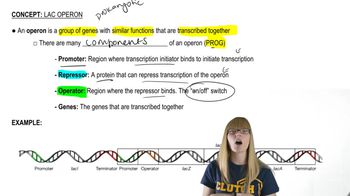
Understand the components of the lac operon: The lac operon consists of the regulatory gene (I), the promoter (P), the operator (O), and the structural genes (Z and Y). The I gene encodes the repressor protein, the P region is where RNA polymerase binds, the O region is where the repressor binds, and Z and Y encode β-galactosidase and permease, respectively.
Analyze the given genotype: I⁺ P⁺ Oᶜ Z⁺ Y⁺. Here, I⁺ indicates a functional repressor protein, P⁺ indicates a functional promoter, Oᶜ indicates a constitutive operator mutation (the repressor cannot bind to the operator), and Z⁺ and Y⁺ indicate functional β-galactosidase and permease genes.
Determine the effect of the Oᶜ mutation: The Oᶜ mutation prevents the repressor protein from binding to the operator. As a result, RNA polymerase can transcribe the structural genes (Z and Y) regardless of whether lactose is present. This means the operon is transcribed constitutively.
Assess the strain's ability to grow on lactose-only medium: Since Z⁺ and Y⁺ are functional, the strain can produce β-galactosidase (to break down lactose) and permease (to transport lactose into the cell). Therefore, the strain is lac⁺ and can grow on lactose-only medium.
Summarize the findings: The genotype I⁺ P⁺ Oᶜ Z⁺ Y⁺ results in constitutive transcription of the operon genes, and the strain is lac⁺ because it can metabolize lactose.

Verified video answer for a similar problem:

This video solution was recommended by our tutors as helpful for the problem above.
Video duration:
1m
Was this helpful?

Key Concepts

Here are the essential concepts you must grasp in order to answer the question correctly.

Lac Operon Structure

The lac operon is a set of genes in E. coli that are involved in the metabolism of lactose. It consists of structural genes (Z, Y, and A) that code for proteins necessary for lactose utilization, a promoter (P) where RNA polymerase binds, and an operator (O) that regulates transcription. Understanding the operon's structure is crucial for determining how mutations affect gene expression.
Recommended video:
Guided course
04:27
Lac Operon Overview

Inducible vs. Constitutive Expression

Inducible expression refers to genes that are turned on in response to specific signals, such as the presence of lactose in the case of the lac operon. In contrast, constitutive expression occurs when genes are continuously expressed regardless of environmental conditions. Identifying whether a genotype leads to inducible or constitutive expression is essential for predicting the growth capabilities of the strain on lactose.
Recommended video:
Guided course
04:29
Induced Mutations

Genetic Mutations and Their Effects

Mutations in the lac operon can lead to different phenotypes, such as lac⁺ (able to utilize lactose) or lac⁻ (unable to utilize lactose). For example, a mutation in the operator (Oᶜ) can cause constitutive expression of the operon, leading to continuous transcription of the genes regardless of lactose presence. Understanding these mutations helps in analyzing the genotype's impact on lactose metabolism.
Recommended video:
Guided course
03:38
Maternal Effect
Related Practice
Textbook Question

Identify which of the following lac operon haploid genotypes transcribe operon genes inducibly and which transcribe genes constitutively. Indicate whether the strain is lac⁺ (able to grow on lactose-only medium) or lac⁻ (cannot grow on lactose medium).

I⁺ P⁻ O⁺ Z⁺ Y⁺

616
views
Textbook Question

Identify which of the following lac operon haploid genotypes transcribe operon genes inducibly and which transcribe genes constitutively. Indicate whether the strain is lac⁺ (able to grow on lactose-only medium) or lac⁻ (cannot grow on lactose medium).

I⁺ P⁺ O⁺ Z⁻ Y⁺

572
views
Textbook Question

Identify which of the following lac operon haploid genotypes transcribe operon genes inducibly and which transcribe genes constitutively. Indicate whether the strain is lac⁺ (able to grow on lactose-only medium) or lac⁻ (cannot grow on lactose medium).

I⁺ P⁺ Oᶜ Z⁺ Y⁻

547
views
Textbook Question

Complete the accompanying table, indicating whether functionally active -galactosidase and permease are produced in the presence and absence of lactose. Use '+' to indicate the presence of a functional enzyme and '−' to indicate its absence. Indicate whether the partial diploid strain is lac⁺ (able to grow on lactose-only medium) or lac⁻ (cannot grow on lactose medium).

1025
views
Textbook Question

List possible genotypes for lac operon haploids that have the following phenotypic characteristics:

The operon genes are constitutively transcribed, but the strain is unable to grow on a lactose medium. List two possible genotypes for this phenotype.

581
views
Textbook Question

List possible genotypes for lac operon haploids that have the following phenotypic characteristics:

The operon genes are never transcribed above a basal level, and the strain is unable to grow on a lactose medium. List two possible genotypes for this phenotype.

574
views