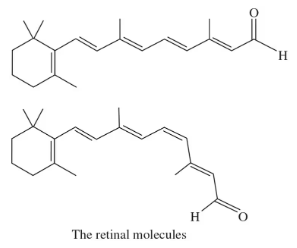
The vision process in animals involves the change of one double bond in retinal from its cis form to its trans form. The structures of cis and trans retinal are shown below. Label which is cis and which is trans.
Verified step by step guidance
1
Understand the difference between cis and trans isomers: Cis isomers have substituents on the same side of the double bond, while trans isomers have substituents on opposite sides of the double bond.
Examine the structure of the retinal molecules provided in the image. Focus on the double bond in question and the positions of the substituents attached to the carbon atoms of the double bond.
Identify the molecule where the substituents are on the same side of the double bond. This is the cis isomer.
Identify the molecule where the substituents are on opposite sides of the double bond. This is the trans isomer.
Label the structures accordingly: The molecule with substituents on the same side of the double bond is labeled as 'cis,' and the molecule with substituents on opposite sides is labeled as 'trans.'
Verified video answer for a similar problem:
This video solution was recommended by our tutors as helpful for the problem above
Video duration:
2m
Play a video:
Was this helpful?
Key Concepts
Here are the essential concepts you must grasp in order to answer the question correctly.
Retinal Structure
Retinal is a light-sensitive molecule found in the photoreceptor cells of the retina. It exists in two isomeric forms: cis and trans. The cis form has a bent structure due to a double bond, while the trans form is more linear. This structural difference is crucial for its function in the vision process, as the conversion between these forms initiates the phototransduction cascade.
Isomerization refers to the process by which a molecule changes its structure without altering its molecular formula. In the context of retinal, the isomerization from cis to trans occurs when it absorbs light. This change is essential for activating the visual pigments in photoreceptors, leading to the perception of light and color.
Phototransduction is the biochemical process by which light is converted into electrical signals in the retina. When retinal changes from its cis to trans form, it triggers a series of reactions involving proteins like opsins. This cascade ultimately results in the hyperpolarization of photoreceptor cells, allowing the brain to interpret visual information.