Pearson+ LogoPearson+ Logo
Ch.4 Introduction to Organic Compounds
Frost - General, Organic and Biological Chemistry 4th Edition
Frost4th EditionGeneral, Organic and Biological ChemistryISBN: 9780134988696Not the one you use?Change textbook
Chapter 1, Problem 77

Draw the skeletal structure and give the name and omega number of the following fatty acid:
CH3CH2CH2CH2CH2HC=CHCH2HC=CHCH2CH2CH2CH2CH2CH2CH2COOH

Verified step by step guidance
1
Identify the functional groups in the molecule. The molecule contains a carboxylic acid group (-COOH) at one end, which classifies it as a fatty acid. Additionally, there are two double bonds in the hydrocarbon chain, making it an unsaturated fatty acid.
Determine the total number of carbon atoms in the molecule. Count all the carbons, including those in the hydrocarbon chain and the carboxylic acid group.
Draw the skeletal structure of the molecule. Represent the hydrocarbon chain as a zigzag line, with the carboxylic acid group (-COOH) at one end. Indicate the positions of the double bonds using double lines between the appropriate carbon atoms.
Assign the name of the fatty acid. Use the IUPAC naming system: (1) Count the total number of carbons in the chain, (2) Identify the positions of the double bonds, and (3) Use the suffix '-enoic acid' to indicate the presence of double bonds. For example, if the double bonds are at carbons 9 and 12, the name would include '9,12-'.
Determine the omega number. The omega number is the position of the first double bond when counting from the methyl end (CH₃) of the fatty acid. Count the carbons starting from the CH₃ group until you reach the first double bond, and record this position as the omega number.

Verified video answer for a similar problem:

This video solution was recommended by our tutors as helpful for the problem above.
Video duration:
4m
Was this helpful?

Key Concepts

Here are the essential concepts you must grasp in order to answer the question correctly.

Fatty Acid Structure

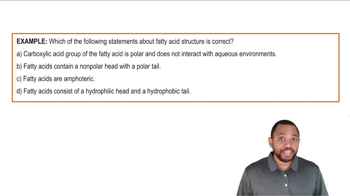
Fatty acids are carboxylic acids with long hydrocarbon chains. The structure typically consists of a hydrophobic tail made of carbon and hydrogen atoms, and a hydrophilic carboxyl group (-COOH) at one end. Understanding the arrangement of these atoms is crucial for identifying the fatty acid's properties and classification.
Recommended video:
Guided course
0:55
Fatty Acids Example 1

Omega Number

The omega number of a fatty acid indicates the position of the first double bond from the methyl end (omega end) of the fatty acid chain. For example, in omega-3 fatty acids, the first double bond occurs at the third carbon from the methyl end. This classification helps in understanding the fatty acid's role in nutrition and health.
Recommended video:
Guided course
03:13
Calculate Oxidation Numbers

Skeletal Structure Representation

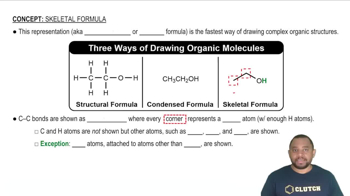
The skeletal structure of a molecule is a simplified representation that shows the arrangement of atoms without depicting all the hydrogen atoms explicitly. In fatty acids, this representation highlights the carbon backbone and functional groups, making it easier to visualize the molecular structure and identify features such as double bonds and chain length.
Recommended video:
Guided course
2:26
Skeletal Formula Concept 1