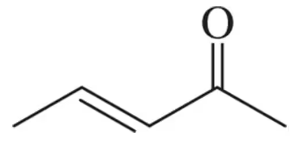
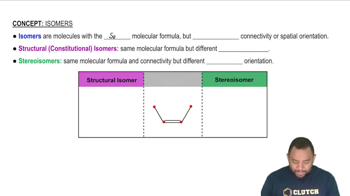
Determine whether each of the following is the cis or the trans stereoisomer: (c)
Verified step by step guidance
1
Examine the structure of the molecule in the image provided. Identify the double bond in the molecule, as cis-trans isomerism occurs around double bonds where rotation is restricted.
Locate the two groups attached to each carbon atom of the double bond. Ensure that each carbon atom of the double bond has two different groups attached to it, which is a requirement for cis-trans isomerism.
Determine the relative positions of the groups attached to the double-bonded carbons. If the identical or similar groups are on the same side of the double bond, the molecule is the cis isomer. If they are on opposite sides, the molecule is the trans isomer.
Use the visual representation in the image to confirm the spatial arrangement of the groups. Pay attention to any wedges or dashes that indicate 3D orientation.
Based on your analysis, classify the molecule as either the cis or the trans isomer. Remember, cis isomers have groups on the same side, while trans isomers have groups on opposite sides.
Verified video answer for a similar problem:
This video solution was recommended by our tutors as helpful for the problem above
Video duration:
2m
Play a video:
Was this helpful?
Key Concepts
Here are the essential concepts you must grasp in order to answer the question correctly.
Stereoisomerism
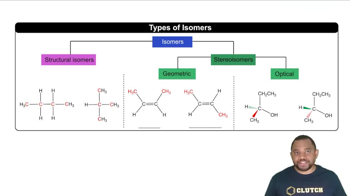
Stereoisomerism refers to the phenomenon where compounds have the same molecular formula and connectivity of atoms but differ in the spatial arrangement of those atoms. This can lead to different physical and chemical properties. The two main types of stereoisomers are geometric isomers (cis/trans) and optical isomers (enantiomers). Understanding stereoisomerism is crucial for determining the specific isomer in question.
Cis and trans isomers are specific types of geometric isomers that arise due to restricted rotation around a double bond or a ring structure. In cis isomers, similar substituents are on the same side of the double bond or ring, while in trans isomers, they are on opposite sides. This distinction affects the physical properties of the compounds, such as boiling points and solubility, making it essential to identify them correctly.
Visual representation, such as structural formulas or molecular models, is vital for identifying cis and trans isomers. These representations help in visualizing the spatial arrangement of atoms and the orientation of substituents around the double bond or ring. Analyzing the image provided in the question will allow one to determine whether the isomer is cis or trans based on the positioning of the substituents.