Explain why it is not possible to draw a skeletal structure for methane.
Verified step by step guidance
1
Methane (CH_4) is the simplest alkane, consisting of one carbon atom bonded to four hydrogen atoms.
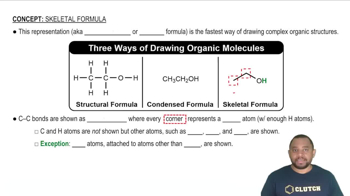
In organic chemistry, a skeletal structure is a simplified representation of a molecule where carbon atoms are represented by the ends and intersections of lines, and hydrogen atoms bonded to carbon are usually omitted.
Skeletal structures are typically used for larger organic molecules where the carbon backbone is more complex.
Since methane has only one carbon atom, there is no carbon-carbon backbone to represent, making a skeletal structure unnecessary and impractical.
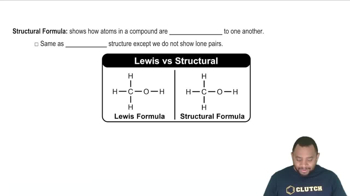
Therefore, methane is typically represented by its molecular formula (CH_4) or a Lewis structure showing the carbon-hydrogen bonds.
Verified video answer for a similar problem:
This video solution was recommended by our tutors as helpful for the problem above
Video duration:
3m
Play a video:
Was this helpful?
Key Concepts
Here are the essential concepts you must grasp in order to answer the question correctly.
Skeletal Structures
Skeletal structures are simplified representations of molecules that depict only the bonding between atoms, typically omitting hydrogen atoms attached to carbon. They are useful for illustrating larger organic molecules where hydrogen atoms are implied rather than explicitly shown.
Methane (CH4) is the simplest alkane, consisting of one carbon atom bonded to four hydrogen atoms. Its tetrahedral geometry means that all hydrogen atoms are equivalent and closely associated with the carbon atom, making it challenging to represent in a skeletal structure where hydrogen atoms are usually omitted.
In methane, the carbon atom undergoes sp3 hybridization, forming four equivalent sigma bonds with hydrogen atoms. This hybridization results in a three-dimensional shape that cannot be effectively captured in a two-dimensional skeletal structure, as it would require showing all hydrogen atoms to accurately represent the molecule.