Back

Aerobic Respiration Summary quiz

Control buttons has been changed to "navigation" mode.
1/15
  • What are the starting molecules involved in aerobic respiration?

    The starting molecules are Carbon Dioxide, ATP, FADH2, and NADH.
  • Which stage of food catabolism is the Krebs Cycle?

    The Krebs Cycle is stage 3 of food catabolism.
  • What is the starting material for the Krebs Cycle?

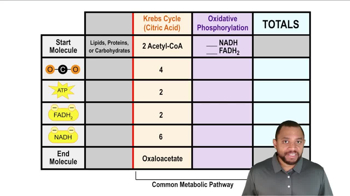
    The starting material is 2 Acetyl CoA molecules.
  • How many CO2 molecules are produced in the Krebs Cycle?

    Four CO2 molecules are produced in the Krebs Cycle.
  • How many ATP molecules are produced during the Krebs Cycle?

    Two ATP molecules are produced during the Krebs Cycle.
  • What are the total outputs of FADH2 and NADH from the Krebs Cycle?

    The Krebs Cycle produces 2 FADH2 and 6 NADH molecules.
  • What is the end molecule of the Krebs Cycle?

    The end molecule is Oxaloacetate.
  • What is the role of FADH2 and NADH in oxidative phosphorylation?

    FADH2 and NADH from the Krebs Cycle are used in oxidative phosphorylation to transfer electrons.
  • How much CO2 is produced during oxidative phosphorylation?

    No CO2 is produced during oxidative phosphorylation.
  • What is the theoretical maximum ATP yield from oxidative phosphorylation?

    The theoretical maximum ATP yield is 18 ATP molecules.
  • What happens to FADH2 and NADH during oxidative phosphorylation?

    FADH2 and NADH are oxidized and do not produce more FADH2 or NADH in this stage.
  • What is the final electron acceptor in oxidative phosphorylation?

    The final electron acceptor is O2 (oxygen).
  • What is formed when oxygen accepts electrons in oxidative phosphorylation?

    Water is formed when oxygen accepts electrons.
  • What are the total outputs for the common metabolic pathway (stages 3 and 4)?

    The total outputs are 4 CO2, 20 ATP, 2 FADH2, and 6 NADH.
  • Which stages make up the common metabolic pathway in aerobic respiration?

    Stages 3 (Krebs Cycle) and 4 (oxidative phosphorylation) make up the common metabolic pathway.