Skip to main content
GOB Chemistry
My Course
Learn
Exam Prep
AI Tutor
Study Guides
Textbook Solutions
Flashcards
Explore
Try the app
My Course
Learn
Exam Prep
AI Tutor
Study Guides
Textbook Solutions
Flashcards
Explore
Try the app
Back
Anaerobic Respiration definitions
You can tap to flip the card.
Anaerobic Respiration
You can tap to flip the card.
👆
Anaerobic Respiration
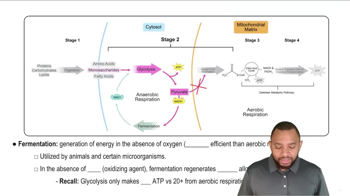
Energy-generating process occurring without oxygen, resulting in less ATP production compared to aerobic pathways.
Track progress
Control buttons has been changed to "navigation" mode.
1/15
Related flashcards
Related practice
Recommended videos
Anaerobic Respiration quiz
Anaerobic Respiration
15 Terms
Anaerobic Respiration
22. Carbohydrate Metabolism
7 problems
Topic
Nicole
Total Energy from Glucose
22. Carbohydrate Metabolism
5 problems
Topic
Nicole
22. Carbohydrate Metabolism
9 topics
15 problems
Chapter
Nicole
Guided course
2:20
Anaerobic Respiration Example 1
1715
views
Guided course
2:22
Anaerobic Respiration Concept 2
1724
views
1
rank
Guided course
2:09
Anaerobic Respiration Example 2
1637
views
1
rank
Terms in this set (15)
Hide definitions
Anaerobic Respiration
Energy-generating process occurring without oxygen, resulting in less ATP production compared to aerobic pathways.
Electron Transport Chain
Series of protein complexes in mitochondria responsible for transferring electrons to generate ATP in the presence of oxygen.
Fermentation
Cytosolic process that regenerates NAD+ from NADH, enabling glycolysis to continue in the absence of oxygen.
Glycolysis
Initial metabolic pathway breaking down glucose into pyruvate, yielding ATP and NADH in the cytosol.
Pyruvate
Three-carbon molecule produced from glycolysis, serving as a key intermediate in both aerobic and anaerobic pathways.
Lactate Fermentation
Pathway in animal muscle cells where pyruvate is reduced to lactate, allowing continued ATP production during low oxygen.
Alcohol Fermentation
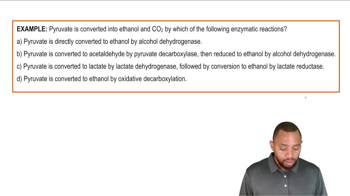
Two-step process in yeast and bacteria converting pyruvate to ethanol and carbon dioxide, regenerating NAD+.
NAD+
Electron carrier molecule regenerated during fermentation, essential for sustaining glycolysis under anaerobic conditions.
NADH
Reduced electron carrier formed during glycolysis, later oxidized to regenerate NAD+ in fermentation.
Lactate Dehydrogenase
Enzyme catalyzing the reversible reduction of pyruvate to lactate, facilitating NADH oxidation.
Alcohol Dehydrogenase
Enzyme responsible for reducing an aldehyde intermediate to ethanol during alcohol fermentation.
Pyruvate Decarboxylase
Enzyme catalyzing the removal of carbon dioxide from pyruvate, forming an aldehyde in alcohol fermentation.
Acetyl CoA Formation
Aerobic process converting pyruvate for entry into the citric acid cycle, bypassed during anaerobic respiration.
Cytosol
Cellular compartment where glycolysis and fermentation occur, especially under anaerobic conditions.
Mitochondrial Matrix
Site of aerobic pyruvate metabolism, inaccessible to pyruvate during anaerobic respiration.
 BackBack
 2:20
2:20