Skip to main content
GOB Chemistry
My Course
Learn
Exam Prep
AI Tutor
Study Guides
Textbook Solutions
Flashcards
Explore
Try the app
My Course
Learn
Exam Prep
AI Tutor
Study Guides
Textbook Solutions
Flashcards
Explore
Try the app
Back
Anaerobic Respiration quiz
You can tap to flip the card.
Why can't the electron transport chain (ETC) produce ATP during anaerobic respiration?
You can tap to flip the card.
👆
Why can't the electron transport chain (ETC) produce ATP during anaerobic respiration?
Because oxygen is not present to serve as the final electron acceptor, so the ETC cannot function.
Track progress
Control buttons has been changed to "navigation" mode.
1/15
Related flashcards
Related practice
Recommended videos
Anaerobic Respiration definitions
Anaerobic Respiration
15 Terms
Anaerobic Respiration
22. Carbohydrate Metabolism
7 problems
Topic
Nicole
Total Energy from Glucose
22. Carbohydrate Metabolism
5 problems
Topic
Nicole
22. Carbohydrate Metabolism
9 topics
15 problems
Chapter
Nicole
Guided course
2:20
Anaerobic Respiration Example 1
1715
views
Guided course
2:22
Anaerobic Respiration Concept 2
1724
views
1
rank
Guided course
2:09
Anaerobic Respiration Example 2
1637
views
1
rank
Terms in this set (15)
Hide definitions
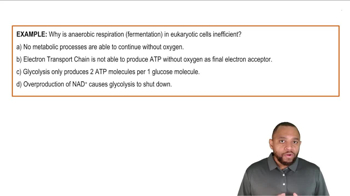
Why can't the electron transport chain (ETC) produce ATP during anaerobic respiration?
Because oxygen is not present to serve as the final electron acceptor, so the ETC cannot function.
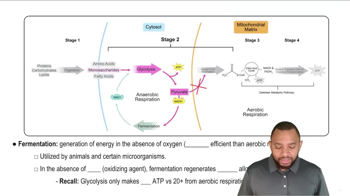
Where does fermentation occur in the cell during anaerobic respiration?
Fermentation occurs in the cytosol of the cell.
What happens to pyruvate in the absence of oxygen?
Pyruvate is redirected to fermentation instead of entering the mitochondrial matrix for acetyl CoA formation.
What is regenerated during fermentation that allows glycolysis to continue?
NAD+ is regenerated during fermentation, allowing glycolysis to continue.
How many ATP molecules are produced per glucose during glycolysis under anaerobic conditions?
Only 2 ATP molecules are produced per glucose during glycolysis in anaerobic conditions.
Why is anaerobic respiration less efficient than aerobic respiration?
Because it produces much less ATP since the ETC and oxidative phosphorylation cannot occur without oxygen.
What enzyme reduces pyruvate to lactate in animal muscle cells?
Lactate dehydrogenase reduces pyruvate to lactate.
During lactate fermentation, what happens to NADH?
NADH is oxidized to NAD+ during lactate fermentation.
Is the reaction catalyzed by lactate dehydrogenase reversible or irreversible?
It is a reversible reaction.
In which organisms does alcohol fermentation primarily occur?
Alcohol fermentation primarily occurs in certain bacteria and yeast.
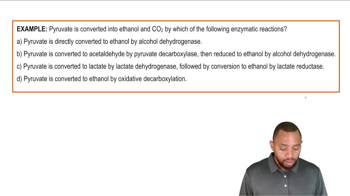
What are the two main products of alcohol fermentation?
The two main products are ethanol and carbon dioxide (CO2).
What enzyme catalyzes the decarboxylation of pyruvate in alcohol fermentation?
Pyruvate decarboxylase catalyzes the decarboxylation of pyruvate.
What is lost from pyruvate during the first step of alcohol fermentation?
One carbon atom is lost as carbon dioxide (CO2).
What enzyme reduces the aldehyde intermediate to ethanol in alcohol fermentation?
Alcohol dehydrogenase reduces the aldehyde intermediate to ethanol.
What is the main purpose of fermentation in anaerobic respiration?
The main purpose is to regenerate NAD+ so glycolysis can continue producing ATP.
 BackBack
 2:20
2:20