Back

Arrhenius Acid and Base definitions

Control buttons has been changed to "navigation" mode.
1/15
  • Arrhenius Acid

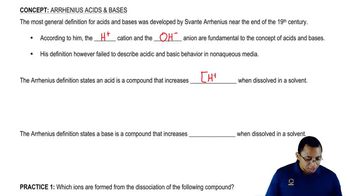
    A substance that, when dissolved in water, increases the concentration of hydrogen ions in the solution.
  • Arrhenius Base

    A substance that, when dissolved in water, increases the concentration of hydroxide ions in the solution.
  • Binary Acid

    A type of acid composed of hydrogen and one other nonmetal element, typically forming in aqueous solutions.
  • Oxy Acid

    A type of acid containing hydrogen, oxygen, and another element, usually forming ions in water.
  • Hydrogen Ion

    A positively charged particle released by acids in water, responsible for acidic properties.
  • Hydroxide Ion

    A negatively charged particle released by bases in water, responsible for basic properties.
  • Aqueous Solution

    A mixture where water acts as the solvent, allowing acids and bases to dissociate into ions.
  • Dissociation

    The process by which a compound separates into ions when dissolved in water.
  • Concentration

    The amount of a specific ion or substance present in a given volume of solution.
  • Limitation

    A restriction or shortcoming, such as the inability of a theory to explain behavior outside aqueous solutions.
  • Strong Acid

    A substance that completely separates into ions in water, maximizing hydrogen ion presence.
  • Weak Acid

    A substance that only partially separates into ions in water, resulting in fewer hydrogen ions.
  • Solvent

    A medium, typically water, in which substances dissolve to form a solution.
  • Product

    A substance formed as a result of the dissociation of an acid or base in water.
  • Ion

    An atom or molecule with an electric charge, produced when acids or bases dissociate in water.