GOB Chemistry
My Course
Learn
Exam Prep
AI Tutor
Study Guides
Textbook Solutions
Flashcards
Explore
My Course
Learn
Exam Prep
AI Tutor
Study Guides
Textbook Solutions
Flashcards
Explore
Back
Arrhenius Acid and Base quiz
You can tap to flip the card.
Define:
What are the two main types of acids discussed in the context of Arrhenius acids and bases?
You can tap to flip the card.
👆
What are the two main types of acids discussed in the context of Arrhenius acids and bases?
The two main types are binary acids and oxy acids.
Track progress
Control buttons has been changed to "navigation" mode.
1/15
Related flashcards
Related practice
Recommended videos
Arrhenius Acid and Base definitions
Arrhenius Acid and Base
15 Terms
Arrhenius Acid and Base
10. Acids and Bases
3 problems
Topic

Jules
Bronsted Lowry Acid and Base
10. Acids and Bases
5 problems
Topic
Jules
10. Acids and Bases - Part 1 of 2
6 topics
13 problems
Chapter
Jules
10. Acids and Bases - Part 2 of 2
8 topics
13 problems
Chapter
Jules
Guided course
03:11
Arrhenius Acids & Bases Concept 1
Jules
4046
views
9
rank
Terms in this set (15)
Hide definitions
What are the two main types of acids discussed in the context of Arrhenius acids and bases?
The two main types are binary acids and oxy acids.
Who developed the earliest and broadest definition of acids and bases?
Arrhenius developed the earliest and broadest definition near the end of the 19th century.
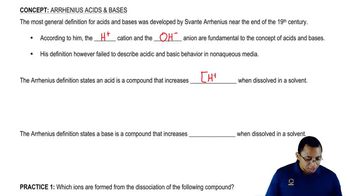
According to Arrhenius, what ion must a compound produce in water to be considered an acid?
It must increase the concentration of H+ ions in water.
What is an example of an Arrhenius acid and its dissociation in water?
HCl is an example; it dissociates into H+ and Cl- in water.
According to Arrhenius, what ion must a compound produce in water to be considered a base?
It must increase the concentration of OH- ions in water.
What is an example of an Arrhenius base and its dissociation in water?
NaOH is an example; it dissociates into Na+ and OH- in water.
What is a major limitation of the Arrhenius definition of acids and bases?
It only applies to aqueous solutions and does not account for acids or bases outside of water.
Why does the Arrhenius definition not recognize some compounds as acids or bases?
Because it requires the presence of H+ for acids and OH- for bases, excluding compounds without these ions.
Does the Arrhenius definition apply to both strong and weak acids?
Yes, as long as the compound produces H+ in water, it is considered an Arrhenius acid.
What fundamental ions did Arrhenius use to identify acids and bases?
He used the H+ cation for acids and the OH- anion for bases.
Why is the Arrhenius definition considered broad?
It was the first definition developed and includes any compound with H+ or OH-.
What must you determine to classify a compound as an Arrhenius acid, base, or neither?
You must look at the products formed when the compound dissociates in water.
What happens if a compound does not produce H+ or OH- in water according to Arrhenius?
It is classified as neither an Arrhenius acid nor base.
What is the solvent required for the Arrhenius definition to apply?
The solvent must be water (aqueous solution).
What will be discussed in later, more precise definitions of acids and bases?
Later definitions will address the limitations of Arrhenius and include compounds without H+ or OH-.