Back

ATP and Energy quiz

Control buttons has been changed to "navigation" mode.
1/15
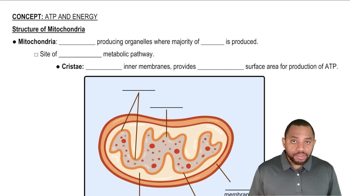
  • What is the primary function of mitochondria in the cell?

    The primary function of mitochondria is to produce ATP, serving as the powerhouse of the cell.
  • What are cristae in mitochondria and what is their purpose?

    Cristae are the folded inner membranes of mitochondria that increase surface area for ATP production.
  • What does ATP stand for?

    ATP stands for Adenosine Triphosphate.
  • What three components make up an ATP molecule?

    ATP is made up of adenine (a nitrogenous base), ribose (a sugar), and three phosphate groups.
  • What is the result of ATP hydrolysis?

    ATP hydrolysis produces ADP (Adenosine Diphosphate), inorganic phosphate (Pi), and releases energy.
  • What is the difference between ATP, ADP, and AMP?

    ATP has three phosphates, ADP has two, and AMP has one phosphate group.
  • What type of bond in ATP stores high energy?

    The high energy is stored in the phosphorus-oxygen (P-O) bonds between the phosphate groups.
  • What is released when a phosphate group is removed from ATP?

    When a phosphate group is removed from ATP, inorganic phosphate and energy are released.
  • What is the process called when water is used to break a phosphate bond in ATP?

    This process is called hydrolysis.
  • Why is ATP considered a high-energy molecule?

    ATP is considered high-energy because breaking its phosphate bonds releases significant energy.
  • How does ATP hydrolysis help drive unfavorable metabolic reactions?

    The energy released from ATP hydrolysis is coupled to unfavorable reactions, making them proceed.
  • What is the role of the mitochondria's matrix?

    The matrix is the innermost compartment of the mitochondria where parts of ATP production occur.
  • What is the space between the inner and outer mitochondrial membranes called?

    It is called the intermembrane space.
  • What happens to glucose in the presence of ATP during metabolism?

    ATP hydrolysis provides energy to add a phosphate to glucose, forming glucose 6-phosphate.
  • Why must some metabolic reactions be coupled with ATP hydrolysis?

    Some reactions are energetically unfavorable and require the energy from ATP hydrolysis to proceed.