Back

Auto-Ionization definitions

Control buttons has been changed to "navigation" mode.
1/14
  • Autoionization

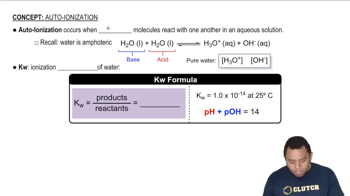
    A process where identical molecules interact to produce ions, crucial for understanding solution acidity and basicity.
  • Amphoteric

    A property allowing a substance to function as either an acid or a base depending on the reaction context.
  • Hydronium Ion

    A positively charged ion formed when a water molecule gains a proton, central to measuring solution acidity.
  • Hydroxide Ion

    A negatively charged ion produced when a water molecule loses a proton, key to determining solution basicity.
  • Ionization Constant of Water

    A specific equilibrium constant representing the product of hydronium and hydroxide ion concentrations in water.
  • Kw

    A symbol denoting the ionization constant of water, with a standard value of 1.0 x 10^-14 at 25°C.
  • Equilibrium Constant

    A ratio expressing the concentrations of products to reactants at equilibrium, excluding liquids and solids.
  • Aqueous Solution

    A mixture where water serves as the solvent, allowing for ion interactions and equilibrium processes.
  • Acidity

    A characteristic determined by the concentration of hydronium ions present in a solution.
  • Basicity

    A characteristic defined by the concentration of hydroxide ions within a solution.
  • Neutral Solution

    A state where hydronium and hydroxide ion concentrations are equal, resulting in neither acidic nor basic properties.
  • pH

    A logarithmic scale value reflecting the concentration of hydronium ions in a solution.
  • pOH

    A logarithmic scale value indicating the concentration of hydroxide ions in a solution.
  • Temperature Dependence

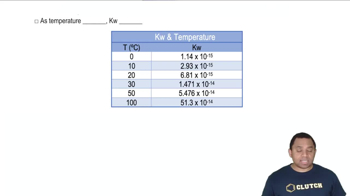
    A relationship where the value of the ionization constant of water changes as temperature varies.