Back

Benzene Reactions definitions

Control buttons has been changed to "navigation" mode.
1/15
  • Benzene

    A six-membered aromatic ring with unique stability due to delocalized pi electrons, resisting addition reactions.
  • Aromatic Compound

    A molecule with a cyclic, planar structure and delocalized pi electrons, resulting in unusual chemical stability.
  • Substitution Reaction

    A process where an atom, typically hydrogen, on a ring is replaced by another group without disrupting aromaticity.
  • Halogenation

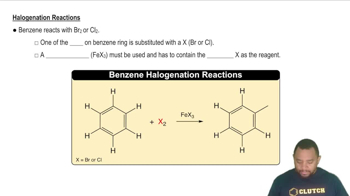
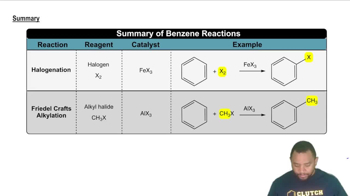
    A reaction introducing a halogen atom, such as bromine or chlorine, onto an aromatic ring using a matching catalyst.
  • Friedel-Crafts Alkylation

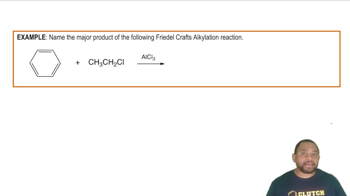
    A method for attaching an alkyl group to an aromatic ring using an alkyl halide and a matching aluminum-based catalyst.
  • Catalyst

    A substance, often a metal halide, that accelerates aromatic substitution without being consumed in the reaction.
  • Alkyl Halide

    An organic molecule containing an alkyl group bonded to a halogen, serving as a reagent in alkylation.
  • Aromaticity

    A property of cyclic molecules with delocalized electrons, conferring exceptional stability and unique reactivity.
  • Pi Bond

    A type of covalent bond formed by sideways overlap of p orbitals, contributing to electron delocalization in rings.
  • Hydrogen Atom

    A substituent on benzene that is replaced during substitution reactions, maintaining the ring's aromatic nature.
  • Bromine

    A halogen element used as a reagent or catalyst component in aromatic halogenation reactions.
  • Chlorine

    A halogen element that can substitute a hydrogen on benzene in the presence of a matching catalyst.
  • FeBr3

    An iron(III) bromide compound acting as a catalyst for introducing bromine into an aromatic ring.
  • FeCl3

    An iron(III) chloride compound used as a catalyst for aromatic chlorination reactions.
  • AlCl3

    An aluminum chloride catalyst essential for Friedel-Crafts alkylation with alkyl chlorides.