Back

Boiling Point Elevation definitions

Control buttons has been changed to "navigation" mode.
1/14
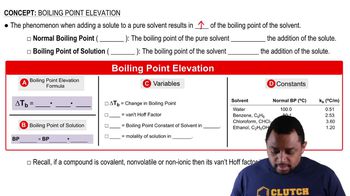
  • Boiling Point Elevation

    Phenomenon where adding solute to a solvent increases the temperature at which the solvent boils.
  • Normal Boiling Point

    Temperature at which a pure solvent transitions to vapor without any solute present.
  • Boiling Point of Solution

    Temperature at which a solvent containing dissolved solute changes to vapor.
  • Solute

    Substance dissolved in a solvent, causing changes in physical properties like boiling point.
  • Solvent

    Primary liquid in which a solute is dissolved to form a solution.
  • Delta Tb

    Symbol representing the increase in boiling point due to the presence of a solute.
  • Van't Hoff Factor

    Number indicating how many particles a compound produces in solution, affecting boiling point change.
  • Boiling Point Constant

    Proportionality value (kb) unique to each solvent, used in calculating boiling point elevation.
  • Molality

    Concentration unit defined as moles of solute per kilogram of solvent.
  • Colligative Properties

    Physical properties of solutions that depend on solute particle number, not their identity.
  • Non-volatile Compound

    Substance with negligible vapor pressure, not easily entering the gas phase.
  • Non-ionic Compound

    Molecule that does not dissociate into ions when dissolved in a solvent.
  • Covalent Compound

    Molecule formed by sharing electrons, typically not producing ions in solution.
  • Electrolyte

    Substance that dissociates into ions in solution, influencing properties like boiling point.