Back

Bond Angles (Simplified) definitions

Control buttons has been changed to "navigation" mode.
1/14
  • Bond Angle

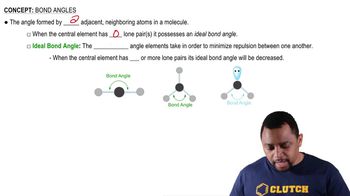
    Angle formed by two adjacent atoms connected to a central atom within a molecule, influenced by electron group arrangement.
  • Central Atom

    Atom in a molecule to which other atoms are bonded and around which electron groups are arranged.
  • Lone Pair

    Non-bonding pair of electrons on the central atom that increases electron repulsion and reduces bond angles.
  • Ideal Bond Angle

    Optimal angle between bonds when the central atom has zero lone pairs, resulting in minimal electron repulsion.
  • Electron Group

    Region of electron density around a central atom, including both bonding pairs and lone pairs.
  • Bonding Group

    Set of electrons shared between the central atom and a surrounding atom, forming a chemical bond.
  • Repulsion

    Force between electron groups that pushes them apart, affecting the spatial arrangement and bond angles.
  • Decreased Bond Angle

    Angle smaller than the ideal value due to the presence of one or more lone pairs on the central atom.
  • 180 Degrees

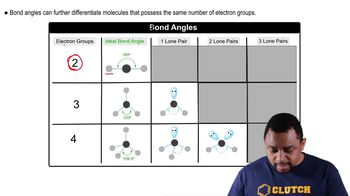
    Ideal bond angle for a central atom with two electron groups and no lone pairs, resulting in a linear arrangement.
  • 120 Degrees

    Ideal bond angle for a central atom with three electron groups and no lone pairs, forming a trigonal planar shape.
  • 109.5 Degrees

    Ideal bond angle for a central atom with four electron groups and no lone pairs, characteristic of a tetrahedral geometry.
  • Spatial Arrangement

    Three-dimensional positioning of atoms and electron groups around a central atom, determining bond angles.
  • Bonding Electron Pair

    Pair of electrons shared between the central atom and a surrounding atom, contributing to molecular shape.
  • Molecular Geometry

    Overall shape of a molecule as determined by the arrangement of electron groups around the central atom.