Back

Bronsted Lowry Acid and Base definitions

Control buttons has been changed to "navigation" mode.
1/15
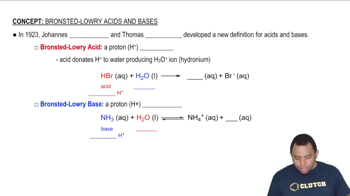
  • Bronsted-Lowry Acid

    A substance that donates a proton (H+) to another species, not limited to aqueous solutions.
  • Bronsted-Lowry Base

    A substance that accepts a proton (H+) from another species, often possessing lone pairs or negative charge.
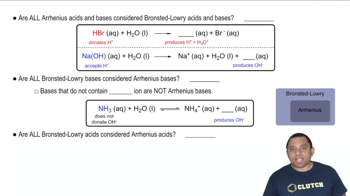
  • Arrhenius Acid

    A substance that increases the concentration of H+ ions when dissolved in water.
  • Arrhenius Base

    A substance that increases the concentration of OH- ions when dissolved in water.
  • Proton

    A hydrogen ion (H+) transferred between acids and bases in Bronsted-Lowry reactions.
  • Conjugate Acid-Base Pair

    Two species related by the gain or loss of a single hydrogen ion, differing by only one H+.
  • Conjugate Acid

    The species formed when a base gains a proton, becoming more positive in charge.
  • Conjugate Base

    The species formed when an acid loses a proton, often carrying a negative charge.
  • Amphoteric Species

    A substance capable of acting as either an acid or a base depending on its reaction partner.
  • Electronegativity

    A measure of an atom's ability to attract electrons, influencing acid strength when bonded to hydrogen.
  • Acid Strength

    A property indicating how readily a substance donates a proton; stronger acids have weaker conjugate bases.
  • Base Strength

    A property indicating how readily a substance accepts a proton; stronger bases have weaker conjugate acids.
  • Polar Bond

    A bond between atoms with differing electronegativities, making hydrogen more easily donated as H+.
  • Hydronium Ion

    The H3O+ ion formed when water accepts a proton, commonly present in acidic solutions.
  • Ionization

    The process by which a molecule forms ions in solution, often incomplete for weak acids and bases.