GOB Chemistry
My Course
Learn
Exam Prep
AI Tutor
Study Guides
Textbook Solutions
Flashcards
Explore
Try the app
My Course
Learn
Exam Prep
AI Tutor
Study Guides
Textbook Solutions
Flashcards
Explore
Try the app
Back
Bronsted Lowry Acid and Base quiz
You can tap to flip the card.
What is the Bronsted-Lowry definition of an acid?
You can tap to flip the card.
👆
What is the Bronsted-Lowry definition of an acid?
A Bronsted-Lowry acid is a proton (H+) donor.
Track progress
Control buttons has been changed to "navigation" mode.
1/15
Related flashcards
Related practice
Recommended videos
Bronsted Lowry Acid and Base definitions
Bronsted Lowry Acid and Base
15 Terms
Bronsted Lowry Acid and Base
10. Acids and Bases
5 problems
Topic

Jules
Acid and Base Strength
10. Acids and Bases
5 problems
Topic
Jules
10. Acids and Bases - Part 1 of 2
6 topics
13 problems
Chapter
Jules
10. Acids and Bases - Part 2 of 2
8 topics
13 problems
Chapter
Jules
Guided course
00:42
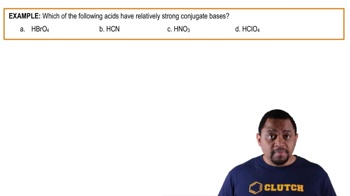
Conjugate Base Strength Example
116
views
1
rank
Guided course
02:17
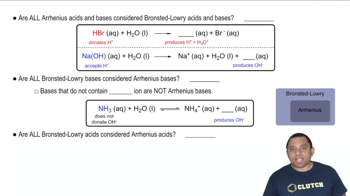
Comparing Bronsted-Lowry and Arrhenius
3371
views
12
rank
Guided course
02:08
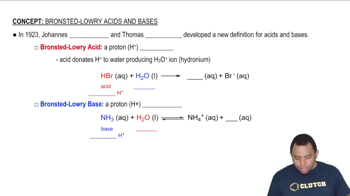
Bronsted-Lowry Acid-Base Theory
3929
views
18
rank
Terms in this set (15)
Hide definitions
What is the Bronsted-Lowry definition of an acid?
A Bronsted-Lowry acid is a proton (H+) donor.
How does the Bronsted-Lowry definition of a base differ from the Arrhenius definition?
Bronsted-Lowry defines a base as a proton (H+) acceptor, while Arrhenius requires a base to produce OH- in water.
What is a conjugate acid-base pair according to Bronsted-Lowry?
A conjugate acid-base pair consists of two species that differ by only one hydrogen ion (H+).
Give an example of a conjugate acid-base pair.
H2O and OH- are a conjugate acid-base pair, differing by one H+.
Can Bronsted-Lowry acids and bases exist in non-aqueous solutions?
Yes, Bronsted-Lowry acids and bases can exist in non-aqueous solutions, unlike Arrhenius acids and bases.
What must a molecule have to be a Bronsted-Lowry acid?
It must contain a hydrogen atom (H+) that can be donated.
What property allows a base to accept a proton?
A base can accept a proton if it has lone pairs or a negative charge.
What is the relationship between acid strength and its conjugate base?
There is an inverse relationship: a strong acid has a weak conjugate base, and a weak acid has a stronger conjugate base.
What does it mean if a species is amphoteric?
An amphoteric species can act as either an acid or a base depending on the reaction conditions; water is a common example.
How can you identify a Bronsted-Lowry acid in a compound?
Look for a hydrogen atom attached to an electronegative element, forming a polar bond that can be broken to release H+.
What happens to water when it donates a proton in a reaction?
When water donates a proton, it becomes OH-, its conjugate base.
What happens to water when it accepts a proton in a reaction?
When water accepts a proton, it becomes H3O+, its conjugate acid.
Why is HF a stronger acid than H2O?
HF is a stronger acid because fluorine is more electronegative than oxygen, making the H-F bond more polar and easier to break.
What does a reversible arrow in an acid-base reaction indicate?
It indicates that the reaction is reversible and does not go to completion, especially for weak acids and bases.
What is the relationship between base strength and its conjugate acid?
A strong base has a weak conjugate acid, and a weak base has a stronger conjugate acid.