Back

Buffers definitions

Control buttons has been changed to "navigation" mode.
1/13
  • Buffer Solution

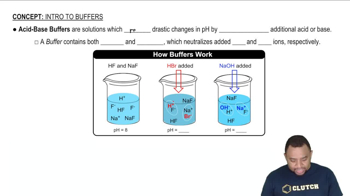
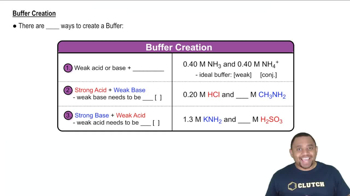
    A mixture of a weak acid and its conjugate base or a weak base and its conjugate acid that resists drastic pH changes.
  • Weak Acid

    A substance that partially dissociates in water, providing limited H+ ions for reactions in buffer systems.
  • Conjugate Base

    A species formed when a weak acid loses an H+ ion, often paired with a metal ion in buffer solutions.
  • pH

    A scale measuring the acidity or basicity of a solution, which buffers help maintain within a narrow range.
  • Buffer Capacity

    The effectiveness of a buffer, increased by higher concentrations of its components, in neutralizing added acids or bases.
  • Buffer Range

    The ratio window, typically between 10:1 and 1:10, where a buffer remains effective in resisting pH changes.
  • Ideal Buffer

    A condition where the concentrations of weak acid and conjugate base are equal, maximizing buffering effectiveness.
  • Strong Acid

    A substance that completely dissociates in water, potentially overwhelming and destroying buffer systems if added in excess.
  • Strong Base

    A compound that fully dissociates in solution, capable of destroying a buffer if present in large amounts.
  • Half Equivalence Point

    The stage in a titration where the amount of weak acid equals its conjugate base, resulting in optimal buffering.
  • Neutralization

    A process where added acids or bases are counteracted by buffer components, minimizing pH shifts.
  • Dilution

    The process of adding water, which does not affect buffer effectiveness since component ratios remain unchanged.
  • Titration

    A laboratory technique used to analyze buffer behavior, especially at the half equivalence point.