GOB Chemistry
My Course
Learn
Exam Prep
AI Tutor
Study Guides
Textbook Solutions
Flashcards
Explore
My Course
Learn
Exam Prep
AI Tutor
Study Guides
Textbook Solutions
Flashcards
Explore
Back
Buffers quiz
You can tap to flip the card.
Define:
What components make up a buffer solution?
You can tap to flip the card.
👆
What components make up a buffer solution?
A buffer solution contains a weak acid and its conjugate base, or a weak base and its conjugate acid.
Track progress
Control buttons has been changed to "navigation" mode.
1/15
Related flashcards
Related practice
Recommended videos
Buffers definitions
Buffers
13 Terms
Buffers
10. Acids and Bases
5 problems
Topic

Jules
Henderson-Hasselbalch Equation
10. Acids and Bases
1 problem
Topic
Jules
10. Acids and Bases - Part 1 of 2
6 topics
13 problems
Chapter
Jules
10. Acids and Bases - Part 2 of 2
8 topics
13 problems
Chapter
Jules
Guided course
03:02
Buffer Solutions
Jules
3752
views
20
rank
Guided course
03:04
Buffer Creation Methods
Jules
2813
views
9
rank
Guided course
02:41
Buffer Solution Example
Jules
2791
views
5
rank
Terms in this set (15)
Hide definitions
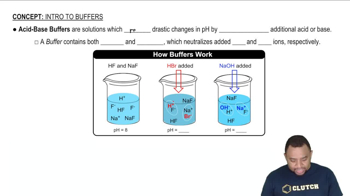
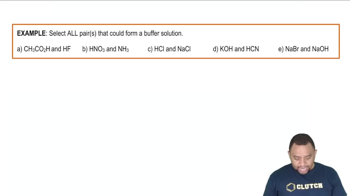
What components make up a buffer solution?
A buffer solution contains a weak acid and its conjugate base, or a weak base and its conjugate acid.
How does a buffer resist drastic changes in pH?
A buffer neutralizes added acids or bases by reacting them with its weak acid or conjugate base, keeping H+ and OH- concentrations constant.
What happens when a small amount of strong base is added to a buffer?
The weak acid in the buffer neutralizes the strong base, causing only a slight increase in pH.
What happens when a small amount of strong acid is added to a buffer?
The conjugate base in the buffer neutralizes the strong acid, causing only a slight decrease in pH.
What is the ideal ratio of weak acid to conjugate base in a buffer?
The ideal ratio is when the concentrations of weak acid and conjugate base are equal, or within a 10:1 to 1:10 range.
What is buffer capacity and how can it be increased?
Buffer capacity is the ability to neutralize added acids or bases, and it increases with higher concentrations of the weak acid and conjugate base.
What is the effect of adding water to a buffer solution?
Adding water dilutes both the acid and base proportionally, so the buffer's effectiveness remains unchanged.
What can destroy a buffer solution?
Adding too much strong acid or strong base can destroy a buffer by overwhelming its neutralizing components.
What is an example of a weak acid and its conjugate base used in a buffer?
HF (hydrofluoric acid) and NaF (sodium fluoride) are examples, with NaF providing the F- conjugate base.
What is the first method for creating a buffer?
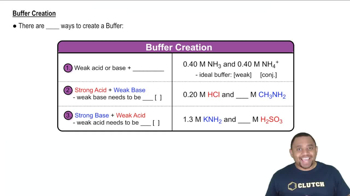
Mixing a weak acid with its conjugate base is the first method for creating a buffer.
What is the second method for creating a buffer?
Mixing a strong acid with a higher amount of a weak base creates a buffer, as long as the weak base is in excess.
What is the third method for creating a buffer?
Mixing a weak acid with a higher amount of a strong base creates a buffer, provided the weak acid is in excess.
Why must the weak component be in higher concentration than the strong component in some buffer creation methods?
If the strong component is in excess, it will destroy the buffer by reacting away the weak component.
What is the buffer range and why is it important?
The buffer range is the 10:1 to 1:10 ratio of weak acid to conjugate base; staying within this range ensures effective buffering.
At what point during a titration is an ideal buffer formed?
An ideal buffer is formed at the half equivalence point, where the concentrations of weak acid and conjugate base are equal.