Back

Chirality definitions

Control buttons has been changed to "navigation" mode.
1/13
  • Chirality

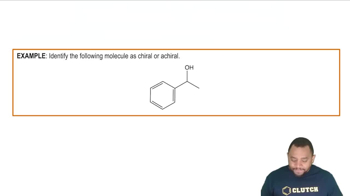
    Property where a molecule's mirror image cannot be perfectly aligned with the original, similar to left and right hands.
  • Chiral Center

    A carbon atom bonded to four distinct groups, creating the potential for non-superimposable mirror images.
  • Achiral

    Describes a molecule lacking a carbon attached to four unique groups, resulting in superimposable mirror images.
  • Optical Isomer

    A molecule that exists in two forms, each rotating plane polarized light differently due to its chiral nature.
  • Enantiomer

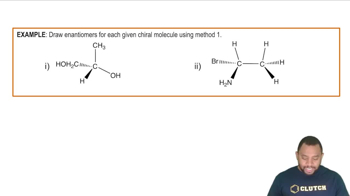
    One of a pair of molecules that are non-superimposable mirror images, each with opposite spatial arrangements.
  • Plane Polarized Light

    A type of light oscillating in a single plane, used to detect optical activity in chiral substances.
  • Optical Activity

    The ability of a substance to rotate the direction of plane polarized light, indicating chirality.
  • Mirror Image Method

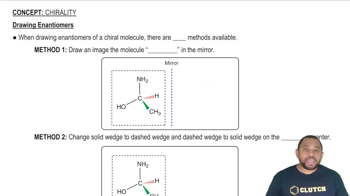
    A drawing technique where a molecule is depicted as seen in a mirror, preserving spatial relationships.
  • Inversion Method

    A drawing approach where the molecule's position is fixed but the bonds' orientations are reversed.
  • Dashed Bond

    A representation in molecular drawings indicating a bond projecting away from the viewer.
  • Wedged Bond

    A depiction in molecular structures showing a bond extending toward the viewer.
  • Spatial Orientation

    The three-dimensional arrangement of groups around a central atom, crucial for distinguishing enantiomers.
  • Unique Group

    A substituent attached to a central atom that differs in identity from the other attached groups.