Back

Classification of Carbohydrates definitions

Control buttons has been changed to "navigation" mode.
1/15
  • Carbohydrates

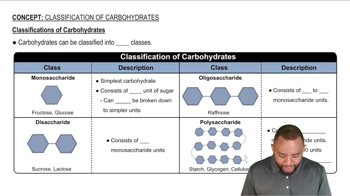
    Organic molecules classified into four main groups based on the number of sugar units they contain.
  • Monosaccharides

    Simplest carbohydrate units, unable to be broken down further, often represented by a single hexagon ring.
  • Disaccharides

    Carbohydrate molecules composed of two monosaccharide units linked by a specific bond.
  • Oligosaccharides

    Carbohydrate chains containing three to ten monosaccharide units, exemplified by raffinose.
  • Polysaccharides

    Large carbohydrate molecules with more than ten monosaccharide units, often exhibiting branching.
  • Glucose

    A common monosaccharide, often depicted as a hexagon, serving as a primary energy source.
  • Fructose

    A monosaccharide found in fruits, structurally similar to glucose but with distinct properties.
  • Sucrose

    A disaccharide formed from two monosaccharides, commonly known as table sugar.
  • Lactose

    A disaccharide present in milk, consisting of two monosaccharide units.
  • Raffinose

    An oligosaccharide composed of three monosaccharide units, serving as an example of its class.
  • Starch

    A polysaccharide made of numerous glucose units, serving as a major energy storage in plants.
  • Glycogen

    A highly branched polysaccharide, functioning as the main storage form of glucose in animals.
  • Cellulose

    A structural polysaccharide in plants, composed of long chains of glucose units.
  • Hexagon Ring

    A common structural representation for the cyclic forms of carbohydrate molecules.
  • Branching

    A structural feature in polysaccharides where additional connections extend from various points on the main chain.