GOB Chemistry
My Course
Learn
Exam Prep
AI Tutor
Study Guides
Textbook Solutions
Flashcards
Explore
My Course
Learn
Exam Prep
AI Tutor
Study Guides
Textbook Solutions
Flashcards
Explore
Back
Covalent Bonds definitions
You can tap to flip the card.
Define:
Covalent Bond
You can tap to
flip the card.
👆
Covalent Bond
A molecular connection formed by the sharing of valence electrons exclusively between nonmetal atoms.
Track progress
Control buttons has been changed to "navigation" mode.
1/14
Related practice
Recommended videos
Guided course
01:10
Covalent Bonds Concept 1
Jules
3796
views
38
rank
1
comments
Guided course
01:38
Covalent Bonds Concept 2
Jules
3477
views
22
rank
Guided course
01:04
Covalent Bonds Example 1
Jules
8283
views
75
rank
2
comments
Terms in this set (14)
Hide definitions
Covalent Bond
A molecular connection formed by the sharing of valence electrons exclusively between nonmetal atoms.
Valence Electron
An outermost electron involved in chemical bonding, crucial for achieving stable electron arrangements.
Nonmetal
An element type that participates in electron sharing to form molecular bonds and achieve stability.
Octet Rule
A stability guideline where atoms aim for eight electrons in their outer shell, resembling noble gases.
Duet Rule
A stability principle for hydrogen, where two electrons in the outer shell mimic helium's configuration.
Noble Gas
An element with a naturally full outer electron shell, serving as a model for stable electron arrangements.
Electron Configuration
The specific arrangement of electrons in atomic shells, determining chemical behavior and stability.
Molecular Compound
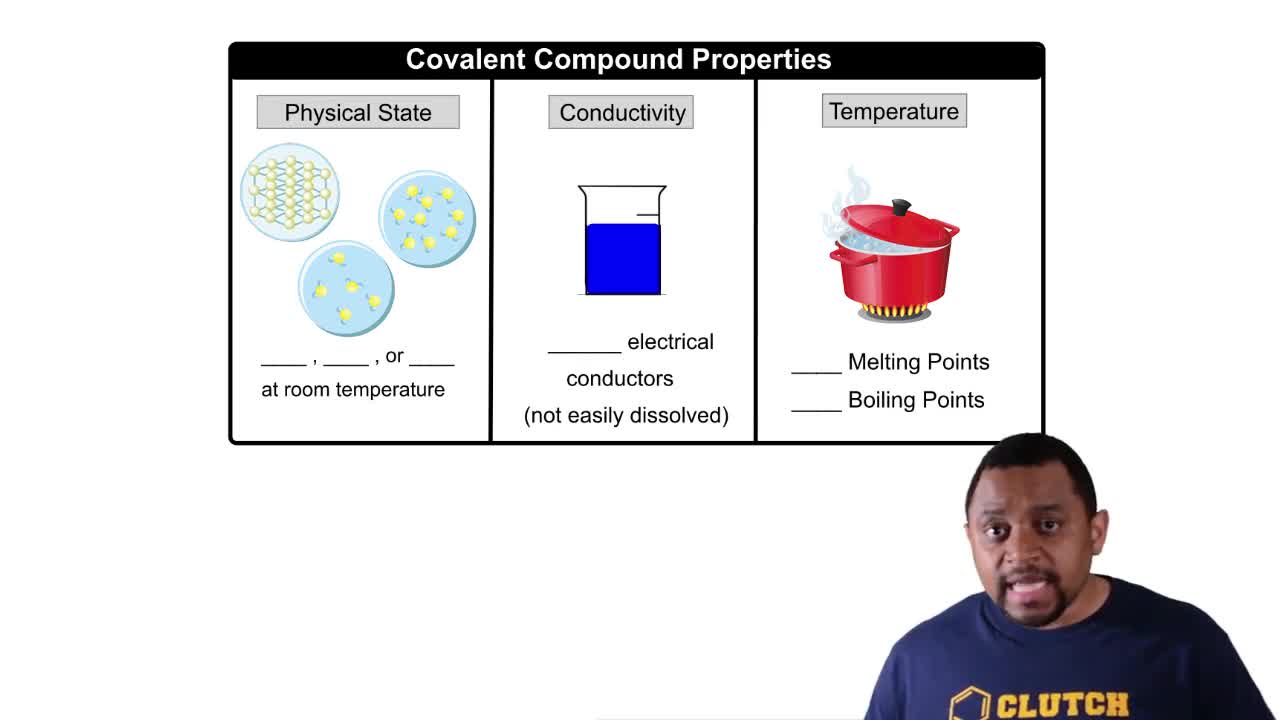
A substance formed from nonmetals sharing electrons, existing as solids, liquids, or gases at room temperature.
Melting Point
The temperature at which a solid molecular compound transitions to a liquid, typically lower for these substances.
Boiling Point
The temperature at which a molecular compound changes from liquid to gas, generally lower than in ionic compounds.
Electrical Conductivity
A property describing how poorly molecular compounds allow electric current to pass, especially in solution.
Electron Sharing
A process where atoms jointly use valence electrons to achieve stable configurations without transferring them.
Solubility
A characteristic indicating how molecular compounds do not easily dissolve in water, affecting their conductivity.
Stable Electron Arrangement
A condition where atoms have filled outer shells, often achieved by mimicking noble gases through bonding.