Back

Covalent Bonds quiz

Control buttons has been changed to "navigation" mode.
1/15
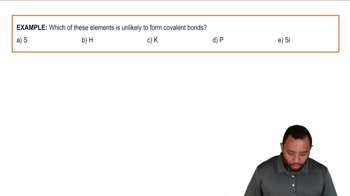
  • What type of elements are involved in covalent bonding?

    Covalent bonding involves only nonmetals.
  • What is the main feature of covalent bonds?

    Covalent bonds involve the sharing of valence electrons between atoms.
  • What rule do most elements follow to achieve stability in covalent bonding?

    Most elements follow the octet rule, aiming for 8 valence electrons.
  • Which rule does hydrogen follow in covalent bonding?

    Hydrogen follows the duet rule, seeking 2 valence electrons.
  • Why do atoms form covalent bonds?

    Atoms form covalent bonds to mimic the electron arrangements of noble gases and achieve stability.
  • How does hydrogen achieve a stable electron configuration through covalent bonding?

    Hydrogen shares its one valence electron to reach a configuration like helium (1s2).
  • What is the electron configuration goal for fluorine in covalent bonding?

    Fluorine aims to achieve a 2p6 configuration, like the noble gas neon.
  • How do nonmetals achieve the octet rule in covalent bonds?

    Nonmetals share electrons so each atom can have 8 valence electrons.
  • Is there any transfer of electrons in covalent bonding?

    No, covalent bonding involves sharing, not transferring, of electrons.
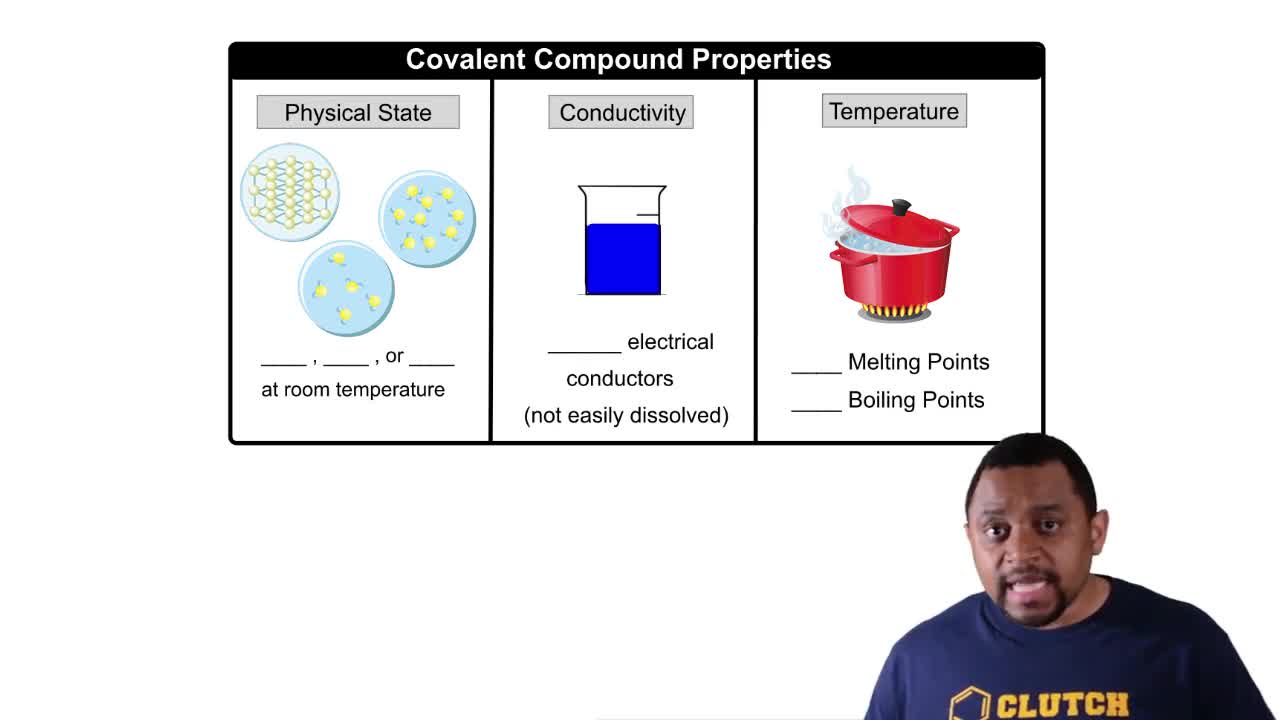
  • What physical states can covalent compounds exist in at room temperature?

    Covalent compounds can be solids, liquids, or gases at room temperature.
  • How do covalent compounds conduct electricity?

    Covalent compounds are poor electrical conductors.
  • Why are covalent compounds poor conductors of electricity?

    They are not easily dissolved in solvents like water, limiting ion movement.
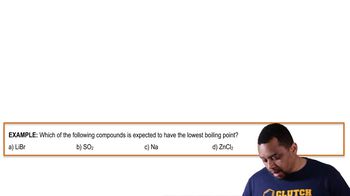
  • How do the melting and boiling points of covalent compounds compare to other compounds?

    Covalent compounds typically have lower melting and boiling points.
  • What does sharing electrons in covalent bonds allow atoms to do?

    It allows atoms to mimic the electron configuration of the nearest noble gas.
  • What is the difference between the duet rule and the octet rule?

    The duet rule applies to hydrogen (2 electrons), while the octet rule applies to most other elements (8 electrons).