GOB Chemistry
My Course
Learn
Exam Prep
AI Tutor
Study Guides
Textbook Solutions
Flashcards
Explore
My Course
Learn
Exam Prep
AI Tutor
Study Guides
Textbook Solutions
Flashcards
Explore
Back
DNA Double Helix definitions
You can tap to flip the card.
Define:
DNA Double Helix
You can tap to
flip the card.
👆
DNA Double Helix
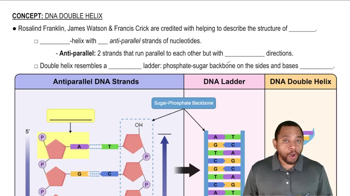
A structure resembling a twisted ladder, formed by two anti-parallel strands of nucleotides with bases paired inside.
Track progress
Control buttons has been changed to "navigation" mode.
1/14
Related practice
Recommended videos
Guided course
3:27
DNA Double Helix Concept 1
Jules
838
views
Guided course
1:49
DNA Double Helix Example 1
Jules
789
views
Terms in this set (14)
Hide definitions
DNA Double Helix
A structure resembling a twisted ladder, formed by two anti-parallel strands of nucleotides with bases paired inside.
Antiparallel Strands
Two chains running alongside each other in opposite directions, enabling proper base pairing in DNA.
Nucleotide
A molecular unit made of a phosphate group, a pentose sugar, and a nitrogenous base, forming DNA's building blocks.
Phosphate Group
A chemical component attached to the five prime carbon of the sugar, linking nucleotides in DNA.
Pentose Sugar
A five-carbon ring structure forming part of the DNA backbone, connecting to both phosphate and base.
Nitrogenous Base
An interior molecule in DNA that pairs with its complement via hydrogen bonds, forming the rungs of the ladder.
Phosphodiester Bond
A linkage joining the phosphate of one nucleotide to the sugar of the next, creating the DNA backbone.
Primary Structure
The linear sequence of nucleotides in a strand, connected by phosphodiester bonds from the five to three prime end.
Sugar-Phosphate Backbone
The exterior framework of DNA, composed of alternating sugars and phosphates, supporting the double helix.
Complementary Base Pairing
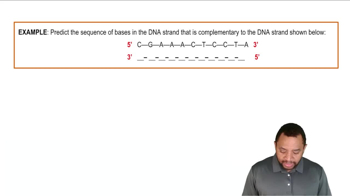
A specific matching of nitrogenous bases across strands, stabilized by hydrogen bonds in the DNA interior.
Hydrogen Bond
A weak attraction holding together paired nitrogenous bases in the center of the DNA double helix.
Five Prime End
The terminus of a DNA strand where the phosphate group is attached to the fifth carbon of the sugar.
Three Prime End
The terminus of a DNA strand where the sugar's third carbon is free or linked to the next nucleotide.
Twisted Ladder
A visual analogy for the DNA double helix, with sugar-phosphate sides and base-pair rungs spiraling around each other.