Back

DNA Double Helix quiz

Control buttons has been changed to "navigation" mode.
1/15
  • Who are credited with describing the structure of DNA as a double helix?

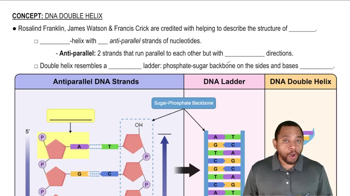
    Franklin, Watson, and Crick are credited with describing the structure of DNA as a double helix.
  • What does it mean when DNA strands are described as antiparallel?

    Antiparallel means the two DNA strands run parallel to each other but in opposite directions.
  • What are the three main components of a nucleotide?

    A nucleotide is composed of a phosphate group, a pentose sugar ring, and a nitrogenous base.
  • To which carbon of the pentose sugar is the phosphate group attached in a nucleotide?

    The phosphate group is attached to the five prime (5') carbon of the pentose sugar.
  • What type of bond links nucleotides together in the DNA backbone?

    Nucleotides are linked together by phosphodiester bonds.
  • In which direction does the primary structure of DNA run?

    The primary structure of DNA runs from the five prime (5') end to the three prime (3') end.
  • How are the two strands of DNA held together?

    The two strands are held together by hydrogen bonds between complementary nitrogenous bases.
  • Where are the sugar-phosphate backbones located in the DNA double helix?

    The sugar-phosphate backbones are located on the exterior sides of the DNA double helix.
  • Where are the nitrogenous bases found in the DNA double helix?

    The nitrogenous bases are found on the interior of the DNA double helix.
  • What does the DNA double helix structure resemble?

    The DNA double helix resembles a twisted ladder.
  • How do the 3' and 5' ends of DNA strands align in the double helix?

    The 3' end of one strand aligns with the 5' end of the other strand due to their antiparallel arrangement.
  • What is the significance of complementary base pairing in DNA?

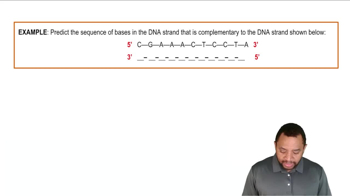
    Complementary base pairing allows the two DNA strands to pair specifically via hydrogen bonds.
  • What structural feature did Franklin, Watson, and Crick help to discover about DNA?

    They helped discover that DNA forms a double helix structure.
  • What is the function of phosphodiester linkages in DNA?

    Phosphodiester linkages connect nucleotides together to form the DNA backbone.
  • How is the DNA ladder transformed into the double helix structure?

    The DNA ladder is twisted by rotating the top and bottom in opposite directions, forming the double helix.