Back

Equivalents definitions

Control buttons has been changed to "navigation" mode.
1/13
  • Equivalent

    A unit representing the moles of charge an ion contributes to a solution, always expressed as a positive value.
  • Milliequivalent

    A subunit equal to one-thousandth of an equivalent, commonly used for measuring small ion quantities.
  • Ion Charge

    The numerical value indicating the electrical charge carried by an ion, used to calculate equivalents.
  • Mole

    A standard quantity in chemistry representing Avogadro's number of particles, used to quantify ions.
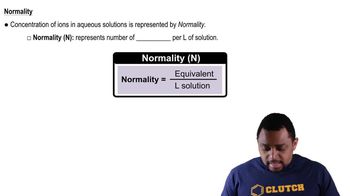
  • Normality

    A concentration unit expressing the number of equivalents of solute per liter of solution.
  • Aqueous Solution

    A liquid mixture where water acts as the solvent for dissolved ions or compounds.
  • Sodium Ion

    A positively charged particle with a single positive charge, often used as an example in equivalence calculations.
  • Iron(III) Ion

    A positively charged particle with a charge of plus three, contributing three equivalents per mole.
  • Body Fluids

    Liquids within organisms where ion concentrations are measured using equivalents.
  • Intravenous Solution

    A sterile fluid administered into veins, where ion content is often quantified in equivalents or milliequivalents.
  • Positive Value

    A characteristic of equivalents, indicating that only non-negative quantities are used in calculations.
  • Concentration

    The amount of a substance, such as ions, present in a specific volume of solution.
  • Liter

    A metric unit of volume used as the denominator in normality calculations.