Skip to main content
GOB Chemistry
My Course
Learn
Exam Prep
AI Tutor
Study Guides
Textbook Solutions
Flashcards
Explore
Try the app
My Course
Learn
Exam Prep
AI Tutor
Study Guides
Textbook Solutions
Flashcards
Explore
Try the app
Back
Gas Stoichiometry definitions
You can tap to flip the card.
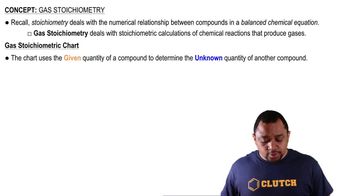
Gas Stoichiometry
You can tap to flip the card.
👆
Gas Stoichiometry
Numerical relationships in reactions involving gases, using balanced equations and gas laws to relate quantities.
Track progress
Control buttons has been changed to "navigation" mode.
1/15
Related flashcards
Related practice
Recommended videos
Gas Stoichiometry quiz
Gas Stoichiometry
15 Terms
Gas Stoichiometry
8. Gases, Liquids and Solids
2 problems
Topic
Jules
Intermolecular Forces (Simplified)
8. Gases, Liquids and Solids
6 problems
Topic
Jules
8. Gases, Liquids and Solids - Part 1 of 2
8 topics
15 problems
Chapter
Jules
8. Gases, Liquids and Solids - Part 2 of 2
7 topics
15 problems
Chapter
Jules
Guided course
02:05
Gas Stoichiometry Concept 2
6291
views
20
rank
Guided course
00:47
Gas Stoichiometry Concept 1
7023
views
23
rank
Guided course
03:51
Gas Stoichiometry Example 1
6534
views
29
rank
Terms in this set (15)
Hide definitions
Gas Stoichiometry
Numerical relationships in reactions involving gases, using balanced equations and gas laws to relate quantities.
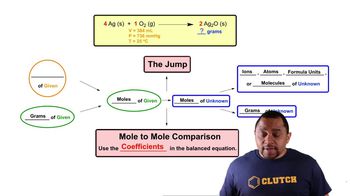
Stoichiometric Chart
A visual tool for tracking conversions between quantities of compounds in a chemical reaction.
Balanced Chemical Equation
A symbolic representation showing equal numbers of each atom type on both sides of a reaction.
Ideal Gas Law
A mathematical relationship connecting pressure, volume, temperature, and moles for a gas sample.
Mole
A counting unit representing a specific number of particles, used to relate quantities in reactions.
Coefficient
A number in a chemical equation indicating the relative amount of each substance involved.
Jump
The transition step from known to unknown information in stoichiometric calculations.
Pressure
A measure of force exerted by gas particles per unit area within a container.
Volume
The amount of three-dimensional space occupied by a gas.
Temperature
A measure of the average kinetic energy of particles in a substance, affecting gas behavior.
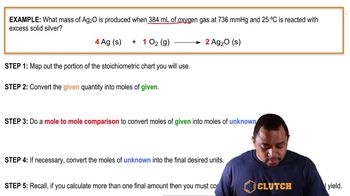
Silver Oxide
A compound formed from silver and oxygen, produced in the example reaction.
Mole-to-Mole Comparison
A ratio derived from equation coefficients, used to relate amounts of different substances.
Grams of Given
The mass of a known substance used as a starting point in stoichiometric calculations.
Unknown Region
The part of a stoichiometric problem where the desired quantity is not initially provided.
Formula Unit
The simplest ratio of ions represented in an ionic compound, used in stoichiometric conversions.
 BackBack
 02:05
02:05