Skip to main content
GOB Chemistry
My Course
Learn
Exam Prep
AI Tutor
Study Guides
Textbook Solutions
Flashcards
Explore
Try the app
My Course
Learn
Exam Prep
AI Tutor
Study Guides
Textbook Solutions
Flashcards
Explore
Try the app
Back
Gas Stoichiometry quiz
You can tap to flip the card.
What does gas stoichiometry involve?
You can tap to flip the card.
👆
What does gas stoichiometry involve?
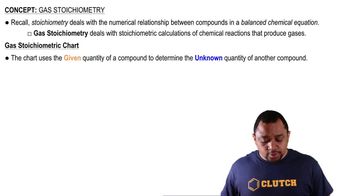
Gas stoichiometry involves stoichiometric calculations in chemical reactions that produce gases.
Track progress
Control buttons has been changed to "navigation" mode.
1/15
Related flashcards
Related practice
Recommended videos
Gas Stoichiometry definitions
Gas Stoichiometry
15 Terms
Gas Stoichiometry
8. Gases, Liquids and Solids
2 problems
Topic
Jules
Intermolecular Forces (Simplified)
8. Gases, Liquids and Solids
6 problems
Topic
Jules
8. Gases, Liquids and Solids - Part 1 of 2
8 topics
15 problems
Chapter
Jules
8. Gases, Liquids and Solids - Part 2 of 2
7 topics
15 problems
Chapter
Jules
Guided course
02:05
Gas Stoichiometry Concept 2
6274
views
20
rank
Guided course
00:47
Gas Stoichiometry Concept 1
7006
views
23
rank
Guided course
03:51
Gas Stoichiometry Example 1
6510
views
28
rank
Terms in this set (15)
Hide definitions
What does gas stoichiometry involve?
Gas stoichiometry involves stoichiometric calculations in chemical reactions that produce gases.
What is the purpose of the stoichiometric chart in gas stoichiometry?
The stoichiometric chart helps convert given quantities of a compound to determine unknown quantities in a balanced chemical equation.
Which law is used to calculate moles of a gas from its volume, pressure, and temperature?
The ideal gas law (PV = nRT) is used to calculate moles of a gas.
How do you calculate moles of a gas using the ideal gas law?
Moles are calculated as n = PV/(RT), where P is pressure, V is volume, R is the gas constant, and T is temperature.
What information is needed to use the ideal gas law for stoichiometric calculations?
You need the gas's pressure, volume, and temperature.
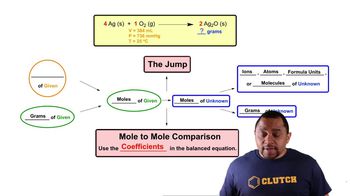
What is the 'jump' in stoichiometric calculations?
The 'jump' refers to moving from known (given) information to unknown information using mole-to-mole comparisons.
How do you convert grams of a compound to moles in stoichiometry?
Divide the grams by the compound's molar mass to get moles.
What is the next step after finding moles of the given compound?
Use the balanced equation's coefficients to convert moles of given to moles of unknown.
How are balanced equation coefficients used in gas stoichiometry?
They are used for mole-to-mole comparisons between compounds.
What can moles of the unknown compound be converted into?
Moles of unknown can be converted into grams, molecules, atoms, ions, or formula units.
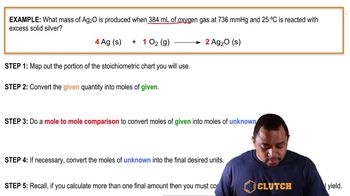
What reaction example is used in the lesson for gas stoichiometry?
The reaction of silver solid and oxygen gas to produce silver oxide is used.
What is the stoichiometric ratio of silver to oxygen in the example reaction?
4 moles of silver react with 1 mole of oxygen gas.
What is the product formed in the example reaction?
The product is silver oxide solid.
Why is it important to review foundational stoichiometry videos before studying gas stoichiometry?
Reviewing foundational videos helps understand the stoichiometric chart and its modifications for gas stoichiometry.
What is the main modification to the stoichiometric chart for gas stoichiometry?
The main modification is incorporating the ideal gas law to find moles from gas properties.
 BackBack
 02:05
02:05