Back

Glycosidic Linkage definitions

Control buttons has been changed to "navigation" mode.
1/14
  • Glycosidic Linkage

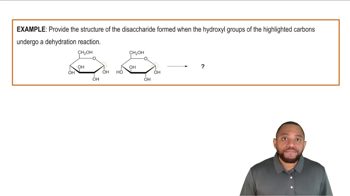
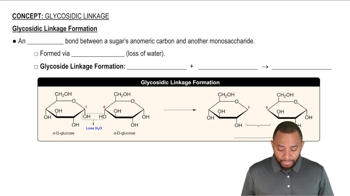
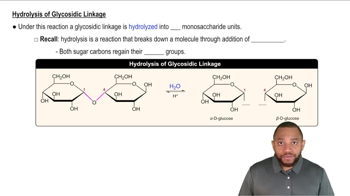
    A covalent bond connecting two monosaccharides, formed by removing water between an anomeric carbon and a hydroxyl group.
  • Anomeric Carbon

    The carbon atom in a sugar ring, usually carbon 1, that forms a new bond during ring closure and linkage formation.
  • Monosaccharide

    A simple sugar unit that can join with another to form larger carbohydrates through specific covalent bonds.
  • Disaccharide

    A carbohydrate composed of two monosaccharide units joined by a glycosidic linkage.
  • Dehydration

    A chemical process where water is removed to connect two molecules, such as forming a bond between sugars.
  • Hydrolysis

    A reaction involving water addition that breaks a bond, splitting a larger molecule into smaller units.
  • Hydroxyl Group

    An -OH functional group on a sugar molecule, crucial for forming and breaking glycosidic linkages.
  • Alpha Linkage

    A bond where the linked hydroxyl group and CH2OH group are on opposite sides of the sugar ring.
  • Beta Linkage

    A bond where the linked hydroxyl group and CH2OH group are on the same side of the sugar ring.
  • Sucrose

    A disaccharide with two anomeric carbons linked, requiring both linkage positions to be specified.
  • Maltose

    A disaccharide formed by two glucose units joined via an alpha 1,4 glycosidic linkage.
  • Cellobiose

    A disaccharide consisting of two glucose units connected by a beta 1,4 glycosidic linkage.
  • Amylopectin

    A branched polysaccharide with alpha 1,6 glycosidic linkages at branch points.
  • CH2OH Group

    A side group on a sugar ring, its orientation relative to the linked hydroxyl group determines alpha or beta linkage.