Back

Glycosidic Linkage quiz

Control buttons has been changed to "navigation" mode.
1/15
  • What is a glycosidic linkage?

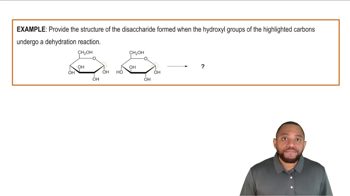
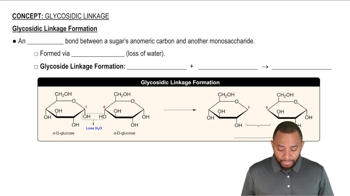
    A glycosidic linkage is a covalent bond formed between the anomeric carbon of one monosaccharide and a hydroxyl group of another monosaccharide.
  • How is a glycosidic linkage formed?

    It is formed through a dehydration reaction, which involves the loss of a water molecule.
  • What type of bond connects two monosaccharides to form a disaccharide?

    A glycosidic linkage connects two monosaccharides to form a disaccharide.
  • What is the result of hydrolyzing a glycosidic linkage?

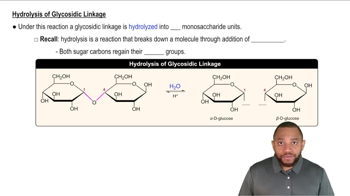
    Hydrolysis of a glycosidic linkage breaks the bond and regenerates the hydroxyl groups on the sugar carbons, separating the monosaccharides.
  • What is required for the hydrolysis of a glycosidic linkage?

    The addition of water is required to hydrolyze a glycosidic linkage.
  • How are alpha and beta glycosidic linkages defined?

    They are defined by the orientation of the linked anomeric hydroxyl group relative to the CH2OH group on the cyclic monosaccharide.
  • What does an alpha glycosidic linkage indicate about the orientation of the groups?

    In an alpha linkage, the anomeric hydroxyl group and the CH2OH group are on opposite sides of the ring.
  • What does a beta glycosidic linkage indicate about the orientation of the groups?

    In a beta linkage, the anomeric hydroxyl group and the CH2OH group are on the same side of the ring.
  • Which carbons are involved in an alpha-1,4 glycosidic linkage?

    The anomeric carbon (carbon 1) of one monosaccharide and carbon 4 of another monosaccharide are involved.
  • What is unique about the glycosidic linkage in sucrose?

    Sucrose contains two linked anomeric hydroxyl groups, so both must be named, resulting in an alpha 1, beta 2 glycosidic linkage.
  • What type of glycosidic linkage is found in maltose?

    Maltose has an alpha-1,4 glycosidic linkage.
  • What type of glycosidic linkage is found in cellobiose?

    Cellobiose has a beta-1,4 glycosidic linkage.
  • What type of glycosidic linkage is found in amylopectin?

    Amylopectin has an alpha-1,6 glycosidic linkage.
  • During hydrolysis of a disaccharide, what happens to the two sugar carbons involved in the glycosidic bond?

    Both sugar carbons regain their hydroxyl (OH) groups after the bond is broken.
  • How do you determine if a glycosidic linkage is alpha or beta in a cyclic monosaccharide?

    You compare the orientation of the anomeric hydroxyl group to the CH2OH group; opposite sides indicate alpha, same side indicates beta.