Back

Halogenation Reaction definitions

Control buttons has been changed to "navigation" mode.
1/13
  • Halogenation

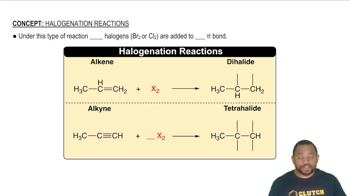
    A process where halogen atoms are incorporated into a molecule at sites of pi bonds, typically using Br2 or Cl2.
  • Alkene

    A hydrocarbon containing a carbon-carbon double bond, serving as a common substrate for addition reactions.
  • Alkyne

    A hydrocarbon with two carbon-carbon pi bonds, requiring two moles of halogen for complete reaction.
  • Pi Bond

    A type of covalent bond found in double or triple bonds, acting as the reactive site for halogen addition.
  • Halogen

    An element from Group 17, such as bromine or chlorine, commonly used to react with unsaturated hydrocarbons.
  • Dihalide

    A molecule resulting from the addition of two halogen atoms to an alkene, with each carbon of the double bond bearing one halogen.
  • Tetrahalide

    A compound formed when four halogen atoms are added to an alkyne, saturating both pi bonds.
  • Reagent

    A substance, such as Br2 or Cl2, introduced to drive the chemical transformation of a substrate.
  • Double Bond

    A pair of shared electron pairs between two carbons, providing a site for halogen addition.
  • Mole

    A unit representing the amount of substance needed per pi bond for complete halogenation.
  • Addition Reaction

    A chemical process where atoms are incorporated into a molecule, typically across a pi bond.
  • Bromine

    A reddish-brown halogen element, often used as Br2 in halogenation reactions.
  • Chlorine

    A greenish-yellow halogen element, commonly used as Cl2 for adding across pi bonds.