Back

Heating and Cooling Curves quiz

Control buttons has been changed to "navigation" mode.
1/15
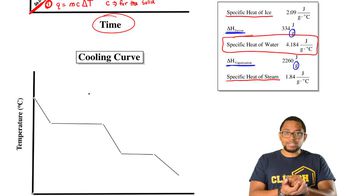
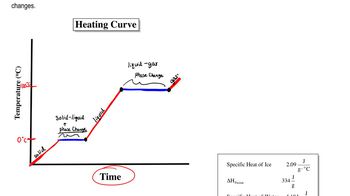
  • At what temperatures do water's phase changes occur on a heating or cooling curve?

    Water melts/freezes at 0°C and boils/condenses at 100°C.
  • What does a flat line on a heating or cooling curve indicate?

    A flat line indicates a phase change where temperature remains constant.
  • During a phase change, what happens to the heat energy added or removed?

    Heat energy is converted into potential energy, not kinetic energy.
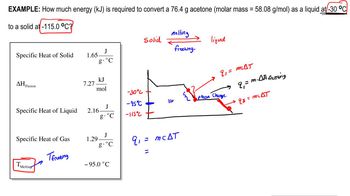
  • Which equation is used to calculate heat during a temperature change?

    The equation q = mcΔT is used during temperature changes.
  • Which equation is used to calculate heat during a phase change?

    The equation q = mΔH is used during phase changes.
  • How do you determine whether to use grams or moles for 'm' in q = mΔH?

    Check the units of ΔH; use grams if ΔH is per gram, or moles if per mole.
  • What happens to the arrangement of particles during a phase change from solid to liquid to gas?

    Particles spread farther apart as they move from solid to liquid to gas.
  • What type of process is a heating curve and what is the sign of q?

    A heating curve is endothermic, so q is positive.
  • What type of process is a cooling curve and what is the sign of q?

    A cooling curve is exothermic, so q is negative.
  • Why is the segment for liquid to gas longer than solid to liquid on a heating curve?

    It takes more energy to separate molecules from liquid to gas than from solid to liquid.
  • What is the relationship between ΔH of vaporization and ΔH of condensation?

    ΔH of vaporization equals -ΔH of condensation.
  • What is the relationship between ΔH of fusion and ΔH of freezing?

    ΔH of fusion equals -ΔH of freezing.
  • What happens to average kinetic energy during a phase change?

    Average kinetic energy remains constant during a phase change.
  • What happens to average kinetic energy during a temperature change?

    Average kinetic energy increases or decreases as temperature changes.
  • What is the main difference between heating and cooling curves?

    Heating curves involve absorbing heat to break bonds (endothermic), while cooling curves involve releasing heat to form bonds (exothermic).