Back

Henderson-Hasselbalch Equation definitions

Control buttons has been changed to "navigation" mode.
1/14
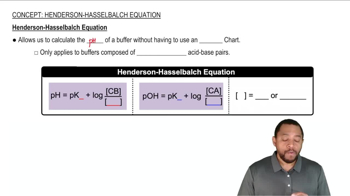
  • Henderson-Hasselbalch Equation

    A formula used to calculate the pH of a buffer solution using the ratio of conjugate base to weak acid or conjugate acid to weak base.
  • Buffer

    A solution that resists significant changes in pH when small amounts of acid or base are added.
  • Conjugate Base

    The species formed when a weak acid donates a proton, playing a key role in buffer systems.
  • Weak Acid

    A substance that partially dissociates in solution, contributing to buffer action with its conjugate base.
  • Conjugate Acid

    The species formed when a weak base accepts a proton, essential in buffer calculations involving Kb.
  • Weak Base

    A substance that partially accepts protons in solution, working with its conjugate acid in buffer systems.
  • pKa

    A logarithmic value representing the acid dissociation constant, used to determine buffer pH with the equation.
  • pKb

    A logarithmic value representing the base dissociation constant, used in buffer pH calculations involving weak bases.
  • Ka

    The equilibrium constant for the dissociation of a weak acid, indicating its strength in solution.
  • Kb

    The equilibrium constant for the dissociation of a weak base, reflecting its ability to accept protons.
  • Molarity

    A concentration unit defined as moles of solute per liter of solution, used in buffer calculations.
  • Moles

    A measure of the amount of substance, calculated as liters times molarity in buffer equations.
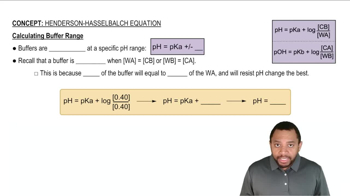
  • Buffer Range

    The pH interval, typically pKa plus or minus 1, where a buffer most effectively resists pH changes.
  • Ideal Buffer

    A situation where concentrations of weak acid and conjugate base are equal, maximizing resistance to pH change.